In the first few weeks after birth, many parents notice a small red or pink spot appear on their baby’s skin — and then watch, with rising worry, as it grows into a raised, bright-red “strawberry” bump over the following weeks.
It is frightening to see something grow on your baby. But here is the reassuring truth: the great majority of these marks are infantile haemangiomas — a common, harmless birthmark that follows a very predictable path. It grows for a few months, then slowly shrinks and fades on its own, usually needing no treatment at all.
This article explains what a haemangioma is, the pattern it follows, and — just as importantly — the small number of situations where it does need a doctor’s attention.
What Is an Infantile Haemangioma?
An infantile haemangioma (also spelled hemangioma) is the most common benign — that is, non-cancerous — growth of infancy. It is simply an overgrowth of tiny blood vessels in the skin, which is why it looks red or bluish. It is not cancer and it does not spread like one.
They are common, affecting somewhere between 4 and 10 in every 100 babies. Some babies are more likely to develop them than others:
- Girls — affected three to five times more often than boys.
- Premature and low-birth-weight babies — the risk rises sharply the smaller the baby; in the tiniest babies (under 1 kg at birth) it approaches 1 in 4.
- Twins and other multiple births.
- They are less common in babies of Indian, Asian and African descent than in fair-skinned babies — but they certainly do occur, and are managed exactly the same way.
The Pattern: Appear, Grow, Then Fade
What makes a haemangioma recognisable is its life cycle. It is this predictable pattern — not any single test — that tells a doctor it is a haemangioma and not something else.
- At or soon after birth. About a third are faintly visible at birth as a pale patch, a small red dot or a bruise-like mark. The other two-thirds appear in the first one to four weeks of life.
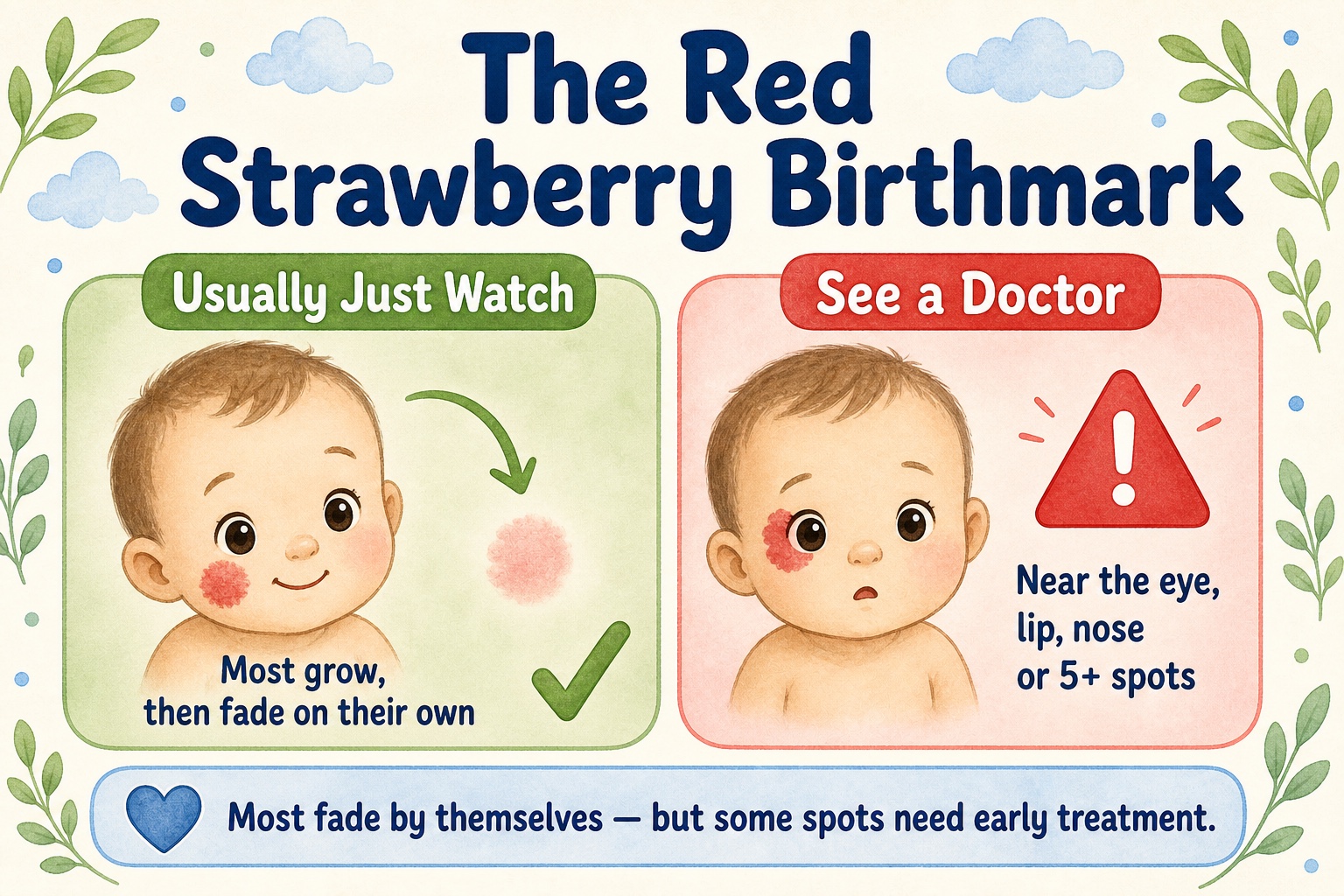
- The growing phase. This is the part that alarms parents. The mark grows fastest between one and two months of age, and reaches about 80% of its final size by three months. Growth generally continues until somewhere between 4 and 12 months, then stops.
- The fading phase. After it stops growing, the haemangioma slowly shrinks and the red colour fades over years. Roughly half have faded by age 5, and about 90% by age 9.
So the natural history is genuinely reassuring — but it is slow, and the growing phase can be nerve-wracking to watch. It helps to take a photo every week or two so you and your doctor can track it objectively rather than by memory.
Why Most Need Nothing but Watching
Because most haemangiomas fade on their own, the right treatment for the majority is no treatment — just careful observation and reassurance. Around 80 to 90% are small, uncomplicated, and are simply monitored until they disappear.
There is a good reason not to rush into surgery: operating on a facial haemangioma early — before it has had the chance to shrink on its own — can leave an unnecessary, permanent scar that is worse than the mark would have been. In most cases, patience gives the better cosmetic result.
When a Birthmark Does Need Treatment
About 1 in 5 haemangiomas (roughly 20%) do need active treatment. This is not because they are dangerous in themselves, but because of where they are or how they behave. Warning situations include:
- Near the eye — even a small haemangioma here can block or distort the developing eye and cause permanent lazy eye (poor vision).
- Around the mouth, jaw, chin or front of the neck (the “beard” area) — this can be linked to a haemangioma inside the airway, which may cause noisy or difficult breathing and needs urgent assessment.
- On the lip, nose or central face — where growth can cause lasting disfigurement.
- Ones that break down (ulcerate) — these become raw, painful and can bleed or get infected.
- Very large or very fast-growing marks anywhere.
The good news is that the first-line treatment for problem haemangiomas is usually a medicine, not an operation. A liquid medicine called propranolol, given by mouth, is very effective at shrinking them and is generally well tolerated under a specialist’s supervision. Surgery is reserved for specific cases — for example, removing leftover loose or scarred tissue after a large haemangioma has faded.
Red Flags — When to Get It Checked Sooner
See a doctor promptly, rather than simply watching, if:
- The mark is near the eye, on the lip or nose, or in the beard area of the jaw and neck.
- Your baby has five or more skin haemangiomas — this is a reason to scan the liver, because there can be matching ones inside the body.
- The haemangioma is breaking down, bleeding, or looks raw and painful.
- Your baby develops noisy breathing along with a beard-area mark.
One more important point: a red or purple birthmark that is fully formed at birth and does not grow or fade in the haemangioma pattern may be a different thing altogether — a vascular malformation (such as a flat “port-wine stain”). These do not disappear on their own and are managed differently, so they are worth a specialist opinion to tell them apart.
What Every Parent Must Know
- A red “strawberry” mark that appears and grows in the first weeks is usually an infantile haemangioma — common and not cancer.
- Most grow for a few months, then fade on their own over years — around 90% are gone by age 9.
- Most need no treatment — rushing to operate can cause an unnecessary scar.
- About 1 in 5 do need treatment — especially near the eye, on the lip/nose, in the beard area, or if ulcerating. The usual first treatment is a medicine (propranolol), not surgery.
When to See a Pediatric Surgeon
Most haemangiomas can simply be watched, but it is worth having any new, fast-growing or awkwardly-placed birthmark assessed early — particularly those near the eye, lips, nose or airway, or any that are ulcerating — because treatment works best when it is started during the growing phase rather than after.
Dr. Tanmay Motiwala is a pediatric surgeon in Raipur, Chhattisgarh, trained at AIIMS Jodhpur. He evaluates birthmarks, infantile haemangiomas and other vascular lesions in children from across Chhattisgarh and central India, and can advise whether a mark simply needs watching or would benefit from early treatment.
Related reading:
- Tongue-Tie in Babies: When It Really Matters — and When It Doesn’t
- Umbilical Hernia in Babies: Why the Belly Button Pops Out — and Why a Coin Won’t Help
- Hydrocele in Baby Boys: Why the Scrotum Looks Swollen — and When to Worry
📋 This article is part of Dr. Motiwala’s Pediatric General & Abdominal Surgery in Raipur services — see the full range of conditions treated, what to expect, and when to see a pediatric surgeon.
Related conditions parents also read
- Tongue-tie in babies (when it really matters)
- Umbilical hernia (why the belly button pops out)
- Hydrocele in baby boys (swelling in the scrotum)
Worried about your child? Dr. Tanmay Motiwala consults in Raipur, Jagdalpur & Rajim. Book an appointment or call +91 83190 84711.
⚠️ Important Disclaimer: This article is for general information and educational purposes only. It is not a substitute for professional medical advice, diagnosis, or treatment. Every child’s condition is different — facts, prognosis, and management can vary significantly from case to case. Please consult a qualified pediatric surgeon for advice specific to your child.
Sources: Coran’s Pediatric Surgery (7th ed); Rob & Smith Operative Pediatric Surgery (7th ed).