
 Dr. Tanmay Motiwala
Pediatric Surgeon, Raipur · Updated 1 Oct 2026 · 7 min read
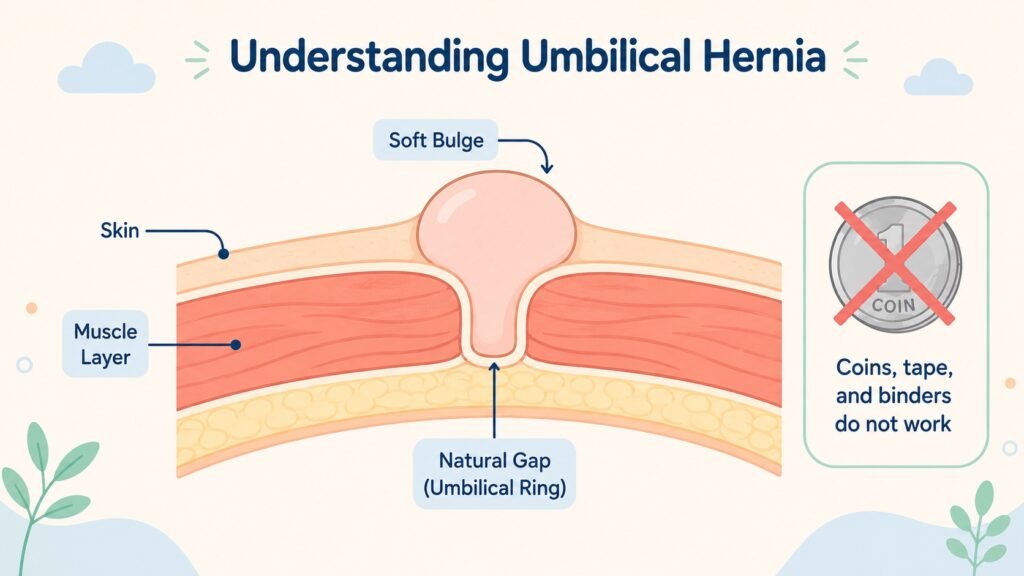
A bulging belly button, or umbilical hernia in babies, is one of the most common worries that bring parents to my clinic in Raipur. The good news is simple: in almost every baby, an umbilical hernia closes on its own without any treatment.
The bad news is that families get a lot of kind but unhelpful advice. For example, coins taped over the belly button, tight belly binders and special oils. None of these actually work. So here is what parents really need to know.
What Is an Umbilical Hernia in Babies?
Before birth, the umbilical cord passes through a natural gap in your baby’s tummy wall, at the navel. After birth, this gap should close as the muscle grows together. In some babies, the gap stays open for a while. A little bit of bowel, covered by skin, pushes out through the gap. That is the soft bulge you see.
It is not the same as a groin hernia. So umbilical hernia in babies is far less risky.
How Common Is Umbilical Hernia in Babies?
It is very common. About 1 in 5 full-term newborns (about 20%) have one. It is even more common in:
- Premature babies — up to 75–80% of small, early-born babies have one.
- Babies of African descent.
- Babies with certain conditions, like Down syndrome or low thyroid (hypothyroidism).
Also, it happens equally in boys and girls.
Does Umbilical Hernia in Babies Close on Its Own?
Yes — almost always. This is the most important fact for parents.
Unlike a groin hernia, the muscle ring at the belly button keeps closing for months and even years after birth. About 80% of umbilical hernias close on their own by 3 to 5 years of age. No medicines, no surgery, no special tricks — just time.
The chance that it closes by itself depends on the size of the gap in the muscle, not how big the bulge looks. A small gap (under 1.5 cm across) almost always closes by itself. However, a larger gap may not.
Is There a Risk of It Getting Stuck?
This is what most parents fear. But the truth is reassuring:
- The risk of an umbilical hernia getting strangled is about 1 in 1,500 — very, very rare.
- This is far less risky than a groin hernia, which is why doctors treat the two very differently.
So unless the bulge becomes suddenly hard, painful, red, or refuses to push back in, there is no rush.
The Coin, the Tape, the Belly Binder — Please Don’t
In many Indian homes, kind relatives suggest pressing a coin or button over the belly button and taping it down. Others suggest wrapping a tight cloth around the tummy. For example, some say this will “push the hernia in” or “speed up healing.”
Please do not do this. Every modern textbook of children’s surgery rejects these old habits. They:
- Do not close the muscle gap any faster.
- Can cause skin rashes, sores, and infection under the tape.
- Sometimes lead to an infection that itself needs treatment.
- Give a false sense of “doing something” while the real answer is simply to wait.
The right approach is to watch, reassure, and follow up. Nothing more.
When Does Umbilical Hernia in Babies Need Surgery?
We keep surgery for specific situations:
- The hernia is still there at 4–5 years of age. Doctors all over the world use this age limit.
- The muscle gap is large — typically more than 1.5–2 cm. This is because large gaps rarely close on their own.
- The hernia is long and trunk-like (“proboscoid”) and clearly not getting smaller. We may repair it earlier.
- Complications occur — sudden pain, hardness, redness, or a bulge that will not push back in (non-reducibility). These are emergencies.
If your child is under 4 and the hernia is small, soft, and painless, the right thing to do is wait. There is no gain in operating early.
What Is the Surgery Like?
It is one of the simpler operations in pediatric surgery, and we do it as a day-care procedure.
- The surgeon makes a small curved cut (under 2 cm) just below the belly button, hidden in the natural crease.
- The surgeon opens the hernia sac and gently returns the contents to the tummy.
- Then the surgeon stitches the muscle edges together with strong dissolving stitches.
- A special stitch (umbilicoplasty stitch) makes the natural “dimple” of the belly button again. So it looks great afterwards.
The operation takes about 30 minutes. Your child is fully asleep (general anaesthesia).
After Surgery
- Your child goes home the same day.
- Paracetamol eases mild discomfort for 24–48 hours.
- The stitches also dissolve on their own.
- Keep the wound dry for 3–4 days; sponge bath only during this time.
- Back to school in about a week, back to sports in 2–3 weeks.
- Infection or small blood collection happens in about 1% of cases.
- The hernia comes back in under 1% of cases.
Common Questions Parents Ask
My baby’s belly button gets huge when she cries — is that bad? No. Crying just makes it easier to see. So it does not damage anything.
Should I avoid tummy-time or massage? No. In fact, normal play and gentle massage make no difference.
Can I push it back in? Yes, a soft umbilical hernia pushes back easily. But there is no need to keep doing it. It will pop out again next time the baby cries — and that is fine.
Will surgery leave a scar? The scar hides inside the belly button, and you can hardly see it.
My child is 6 and still has it — is it too late? No. Repair at this age is simple, and the results are excellent.
When to See a Pediatric Surgeon
Book a consultation if:
- Your child has an umbilical hernia that has not closed by age 4.
- The gap feels large (you can fit a fingertip in easily).
- The hernia is painful, red, or tender — this is urgent.
- The bulge suddenly becomes hard and won’t push back in — go to the emergency room.
For everything else — a small, soft, painless belly-button bulge in a baby — the textbook answer is simply: wait, watch, and reassure.
Dr. Tanmay Motiwala is a pediatric surgeon practising in Raipur, Chhattisgarh. He performs day-care umbilical and inguinal hernia repairs in children of all ages, with attention to a neat cosmetic result. To book a consultation, visit the Contact page or call the clinic directly.
Related reading:
- My Child Has a Swelling Near the Groin — Could It Be a Hernia?
- Hydrocele in Baby Boys: Why the Scrotum Looks Swollen
Sources: Coran’s Pediatric Surgery (7th ed); Rob & Smith Operative Pediatric Surgery (7th ed); DK Gupta Pediatric Surgery Vol 1. Further reading for parents: Umbilical hernia, NHS.
📋 This article is part of Dr. Motiwala’s Pediatric General & Abdominal Surgery in Raipur services — see the full range of conditions treated, what to expect, and when to see a pediatric surgeon.
Related conditions parents also read
- Inguinal hernia in children (groin swelling)
- Common pediatric surgical conditions every parent should know
- Hydrocele in baby boys
Need a pediatric surgical consultation in Chhattisgarh? View current OPD locations and timings in Raipur and Jagdalpur, or book an appointment. Families from Bhilai, Durg, Bilaspur and other cities can call ahead to plan the most suitable consultation location.
⚠️ Important Disclaimer: This article is provided purely for educational and awareness purposes. The information here is not a substitute for medical advice, diagnosis, or treatment, and should not be considered as an OPD or clinical consultation. Every child is different — symptoms that look the same may have different causes. If your child has any of the conditions or symptoms discussed, please consult your nearest qualified pediatric surgeon in person for an examination and personalised advice. In an emergency, go to the nearest hospital immediately.