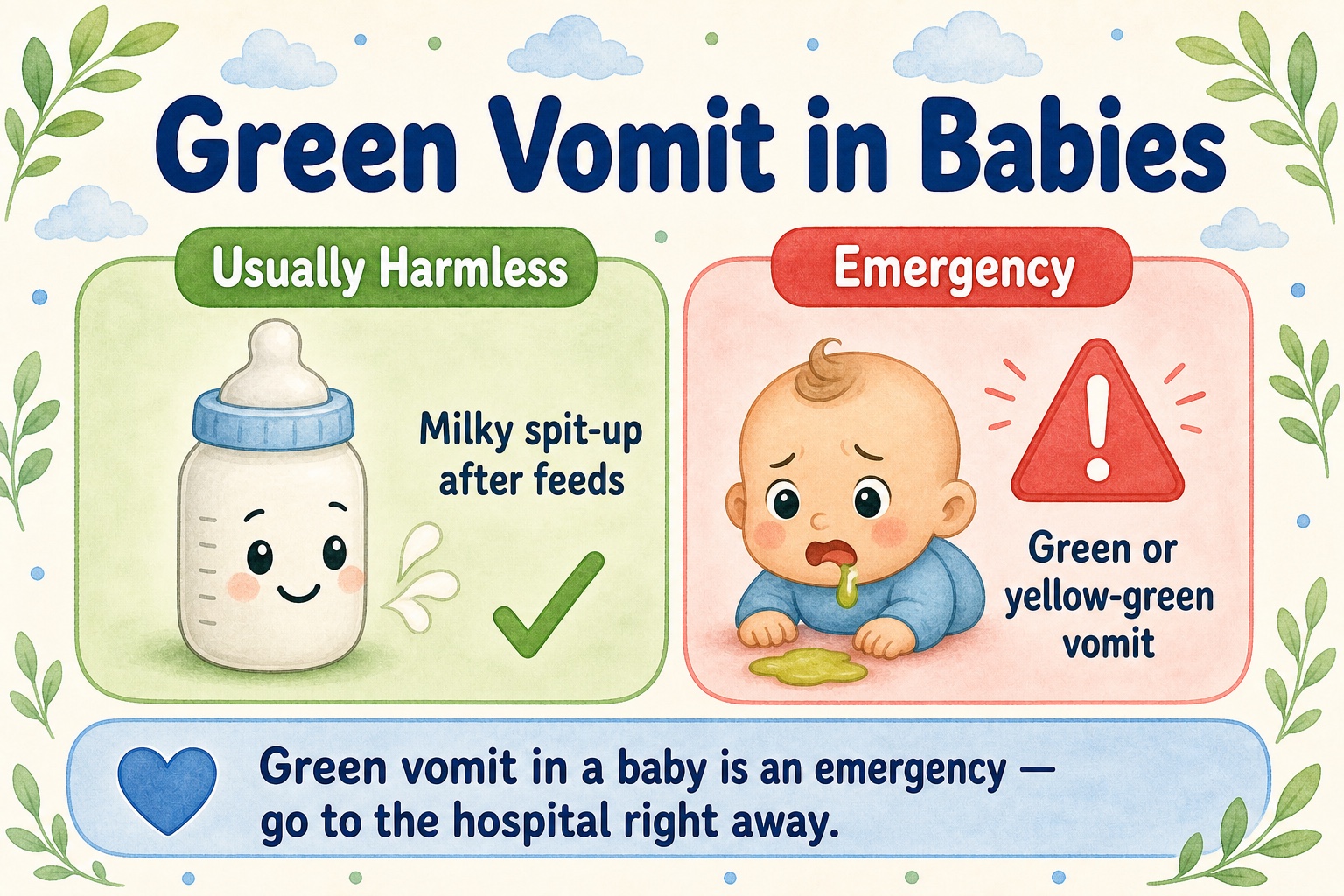
Most of what a baby brings back up is harmless — a little milk, a curdled bit of feed. But there is one thing that changes everything about how quickly you must act: the colour green.
Green or yellow-green vomit in a baby is not a stomach bug to sleep on until morning. It can be the first and only sign that the bowel has twisted and is losing its blood supply — one of the few true surgical emergencies of the newborn period.
There is one rule every parent should hold on to:
> Green (bile-stained) vomiting in a baby must be treated as a surgical emergency until proven otherwise. Go to a hospital now — do not wait overnight.
This article explains why a colour can matter so much, and why surgeons treat it as a race against the clock.
Why the Colour Matters: Milk vs Green
Where the vomit comes from in the gut decides its colour, and that is the whole point.
- Milky or curdled (non-bilious) vomit — this comes from the stomach. It is typical of ordinary reflux or, when forceful and repeated, of pyloric stenosis. These still need a doctor, but they are not the same emergency.
- Green or yellow-green (bile-stained) vomit — bile is added to food below the stomach, where the bile duct joins the gut. So when a baby vomits green, it usually means there is a physical blockage further down the intestine — and in a young baby, the most dangerous cause of that is a twisted bowel.
This is why doctors ask so insistently about the colour. “Green” is not a detail — it is the whole alarm.
What Is Malrotation and Midgut Volvulus?
While a baby is developing in the womb, the intestines make a set turn and then fix themselves neatly into place along the back wall of the abdomen. In some babies this fixing does not happen properly — a condition called malrotation.
The danger of malrotation is not the position itself — it is that almost the whole small intestine ends up hanging from a narrow stalk instead of being anchored along a broad base. That stalk carries the main blood vessels to the bowel. Because the base is so narrow, the bowel can twist around it like a loop of rope — this twist is called a midgut volvulus — and the twist chokes off the blood supply to nearly the entire small bowel at once.
Why It Is So Urgent — The Clock
Once the bowel twists and its blood supply is cut off, the intestine begins to die within hours. This is why the medical response is so different from an ordinary illness.
If a twist is suspected together with warning signs — a tense abdomen, a baby in shock, or blood in the stool — surgeons will take the child straight to the operating theatre, even skipping scans, because there is no time to lose. Even when the baby is stabilised first with fluids, that preparation should not delay the operation by more than one to two hours.
Parents deserve the honest picture, because it is the honest picture that explains the urgency:
- When a volvulus is caught and operated on early, before the bowel is damaged, the outlook is good — overall death rates are under 10%.
- When the diagnosis is delayed and much of the bowel dies, the danger rises steeply. If more than about three-quarters (75%) of the intestine becomes necrotic, death rates climb to 65% or higher.
- Children who survive a late diagnosis may lose so much intestine that they cannot absorb enough nutrition to live — a condition called short bowel syndrome — and can depend on intravenous (drip) feeding for years or for life.
The difference between these outcomes is measured in hours. That is the entire reason for the “green vomit = go now” rule.
When Does It Happen?
Malrotation with volvulus is mostly a problem of the very young. About half to two-thirds of all cases appear in the first month of life, and most of those show up in the very first week. Around three-quarters of all cases have declared themselves by the first birthday.
But it is not only a newborn problem — a twist can happen for the first time in an older child or even an adult who has silently had malrotation all along. So bilious vomiting is taken seriously at any age.
Warning Signs Parents Must Act On
Take your baby to the nearest hospital immediately if you see:
- Green or yellow-green vomiting — the single most important sign.
- Sudden, inconsolable crying or a baby drawing up the legs in pain.
- A swollen, tense or tender tummy.
- Blood or a red-currant, jelly-like material in the stool.
- A baby who becomes pale, floppy, cold or unusually sleepy, or who refuses feeds.
Do not try to “wait and see” with a green-vomiting baby, and do not accept being sent home without the vomit colour being taken seriously.
How It Is Diagnosed and Treated
When there is time to confirm the diagnosis, the key test is an upper gastrointestinal contrast study — the baby swallows a dye that outlines the gut on X-ray and shows the tell-tale twisted, “corkscrew” pattern. An ultrasound can also show a “whirlpool” of the vessels wrapping around each other. When warning signs are already present, surgery does not wait for these.
The operation is called Ladd’s procedure. The surgeon untwists the bowel, divides the abnormal bands that are kinking the intestine, spreads out the broad sheet of tissue the bowel hangs from so it is far less likely to twist again, arranges the intestine in a safe position, and removes the appendix (because the operation leaves it in an unusual place where a future appendicitis would be confusing). It can be done through an open incision or by keyhole surgery.
Importantly, even when malrotation is discovered by chance — without a twist — surgeons usually recommend correcting it, precisely to prevent an unpredictable, catastrophic volvulus later in life.
What Every Parent Must Know
- Green vomit in a baby is an emergency — not a stomach bug. Go to a hospital straight away.
- Milky vomit comes from the stomach; green vomit points to a blockage lower down, and in a baby that can mean a twisted bowel.
- A twisted bowel loses its blood supply within hours — outcomes depend almost entirely on how fast it is treated.
- Caught early, the operation (Ladd’s procedure) has a very good outcome. Caught late, it can cost most of the intestine.
When to See a Pediatric Surgeon
Any baby with green (bile-stained) vomiting needs to be seen urgently — the same hour, not the next day. If a twisted bowel is suspected, the workup and any surgery are extremely time-sensitive and are best done at a centre with paediatric surgical facilities.
Dr. Tanmay Motiwala is a pediatric surgeon in Raipur, Chhattisgarh, trained at AIIMS Jodhpur. He evaluates and manages newborns and infants with bilious vomiting, malrotation and midgut volvulus from across Chhattisgarh and central India. If your baby ever vomits green, treat it as an emergency and seek surgical assessment immediately.
Related reading:
- My Baby Throws Up Forcefully After Every Feed — Could It Be Pyloric Stenosis?
- My Baby Has Sudden, Severe Stomach Pain and Passed Blood in the Stool — What Is Intussusception?
- Baby Not Passing Stool Since Birth? It Could Be Hirschsprung Disease
📋 This article is part of Dr. Motiwala’s Pediatric General & Abdominal Surgery in Raipur services — see the full range of conditions treated, what to expect, and when to see a pediatric surgeon.
Related conditions parents also read
- Pyloric stenosis (forceful vomiting in babies)
- Intussusception (sudden tummy pain and blood in the stool)
- Hirschsprung disease
Worried about your child? Dr. Tanmay Motiwala consults in Raipur, Jagdalpur & Rajim. Book an appointment or call +91 83190 84711.
⚠️ Important Disclaimer: This article is for general information and educational purposes only. It is not a substitute for professional medical advice, diagnosis, or treatment. Every child’s condition is different — facts, prognosis, and management can vary significantly from case to case. Please consult a qualified pediatric surgeon for advice specific to your child.
Sources: Coran’s Pediatric Surgery (7th ed); Rob & Smith Operative Pediatric Surgery (7th ed).