 Dr. Tanmay Motiwala
Pediatric Surgeon, Raipur · Updated 30 Sep 2026 · 8 min read
An hour ago your son was perfectly well. Now he is suddenly doubled over with severe pain in one side of the scrotum. He may also feel sick and vomit. The pain did not build up slowly. It came on suddenly, often waking him from sleep or starting during play or sport. This is the classic picture of testicular torsion.
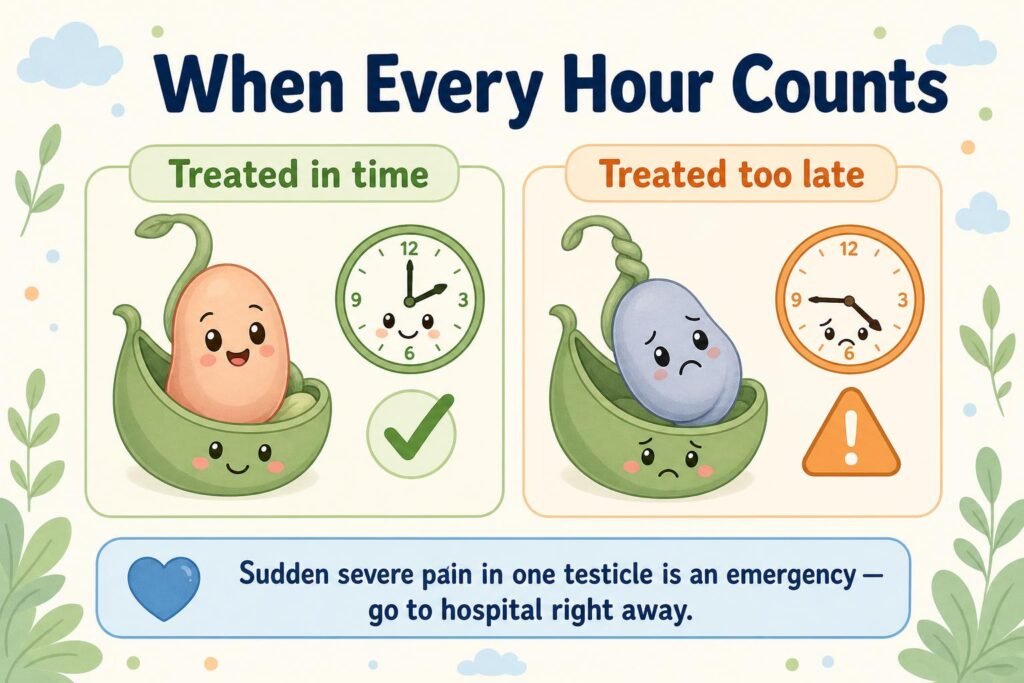
This sudden, one-sided testicle pain is the warning sign of testicular torsion. It is one of the few true emergencies in a boy’s body where the clock decides the outcome. A surgeon can usually save a twisted testicle if he operates within a few hours. Wait too long, and it cannot be saved.
If your son has sudden, severe pain in one testicle, do not wait at home and do not wait until morning. Go to a hospital with surgical facilities now.
What Is Testicular Torsion?
The testicle hangs inside the scrotum from a cord, the spermatic cord, which carries its blood supply. In some boys, the testicle is not anchored normally. It can swing and turn freely, like a clapper inside a bell. Doctors call this a bell-clapper deformity.
Testicular torsion happens when the testicle twists on its own cord. First, the twist squeezes the veins shut, so blood pools and the testicle swells. Then the swelling chokes off the artery that brings blood in, cutting off oxygen. Without blood, the testicle begins to die.
That is why this is a race against time. Every hour the testicle stays twisted, more of it dies.
Which Boys Get Testicular Torsion, and When?
Torsion can happen at any age, but there are two peak times in a boy’s life:
1. Around puberty, most commonly between 12 and 16 years. This is by far the bigger group. At puberty the testicle grows fast and gets more blood flow. Together with a bell-clapper deformity, this makes it prone to twisting. This is the classic teenager who wakes at night with sudden agony in one testicle.
2. In newborn babies (around birth). This is a different type of torsion. The whole testicle and its coverings twist together, often before birth. It usually shows up as a firm, swollen, discoloured scrotum that is not painful. If you notice this in a newborn, show a doctor straight away.
Warning Signs of Testicular Torsion
These signs point to torsion rather than a milder cause:
- Sudden, severe pain in one testicle, not a slow ache that built up over days. It often starts very abruptly.
- Nausea and vomiting. Feeling sick along with the pain is common with torsion and uncommon with milder causes.
- A swollen, tender testicle that sits higher than the other, sometimes lying sideways (horizontally) instead of hanging straight down.
- Pain that does NOT ease when you lift the testicle. (In milder infections, lifting often gives relief. With torsion it does not.)
Doctors also check the cremasteric reflex. Normally, stroking the inner thigh makes the testicle on that side lift up. In torsion, this reflex is usually absent, and that is one of the most useful signs. But it is not perfect. The reflex is still present in up to 10% of boys who truly have torsion. So even if a doctor finds the reflex, it does not rule out torsion when the story is suspicious.
The honest message for parents: there is no single sign you can rely on at home. Treat sudden, severe, one-sided testicle pain as torsion until a surgeon proves otherwise.
Testicular Torsion: Why Every Hour Matters
No parent should be shielded from this part, because it shows exactly why speed saves the testicle.
The chance of saving the testicle falls steadily the longer it stays twisted. From the time the pain starts:
- Within 6 hours: surgeons can save about 95% of testicles.
- 6 to 12 hours: about 80%.
- 13 to 18 hours: about 60%.
- 19 to 24 hours: about 40%.
- Beyond 24 hours: about 20%, and after 48 hours, only about 10%.
Damage to the testicle begins quietly within the first 4 to 8 hours. In rare cases, permanent damage can happen in as little as 2 hours. Even when surgery saves the testicle, it can still shrink (atrophy) over the next weeks if it went without blood for too long. The risk of this late shrinking is under 10% if surgery is within 12 hours. But it rises to around 40% at 12–24 hours, and about 75% beyond 24 hours.
So a surgeon will not wait. If the story sounds like torsion, the boy goes to the operating theatre. The surgeon skips scans if they would cause any delay.
How Doctors Diagnose It
Doctors diagnose torsion mainly from the story and the examination (a clinical diagnosis). When the picture is classic, the surgeon takes the boy straight to theatre without waiting for tests.
When the diagnosis is truly unclear, the best test is a colour Doppler ultrasound. This scan shows whether blood is flowing into the testicle. In torsion, flow is low or absent. Sometimes the scan shows the twisted cord directly. But the scan must never become a reason to delay surgery when suspicion is high.
How Surgeons Treat It
The treatment is an emergency operation called scrotal exploration.
Through a small cut, the surgeon untwists the cord. Then the surgeon wraps the testicle in warm gauze to see if its colour and blood supply come back:
- If the testicle recovers, the surgeon stitches it in place so it can never twist again (orchidopexy).
- If the testicle is already dead, the surgeon has to remove it (orchiectomy). Dead tissue left behind causes infection and harm.
The surgeon always fixes the other testicle in the same operation, even though it is healthy. This is one of the most important points. The bell-clapper deformity that let one side twist is present on both sides in at least half of boys. If the surgeon does not stitch down the second testicle, it can twist later, and then the boy could lose both. Fixing it now prevents that.
Will It Affect Fertility?
This deserves an honest answer. Losing one testicle does not usually stop a man from fathering children, because the other testicle can make up for it. However, research shows that even when surgeons save a testicle, fertility can be mildly affected. Some men have lower sperm counts or weaker sperm movement later in life. The longer the testicle was twisted, the bigger this effect tends to be. Experts still debate the reasons. They may include immune effects, less blood flow to the other side, or a difference present from birth. It is one more reason to get to hospital quickly. It is also why these boys should have long-term follow-up.
What Every Parent Must Know
- Sudden, severe pain in one testicle is an emergency, day or night.
- Do not apply heat, give painkillers, and “wait to see if it settles.”
- Do not wait until the morning or for a regular clinic appointment.
- Go directly to a hospital that can do emergency surgery. Tell them you are worried about testicular torsion, and ask for it by name.
The single biggest factor in saving the testicle is how fast the boy reaches the operating theatre.
When to See a Pediatric Surgeon
Any boy with sudden testicle or groin pain needs an urgent check. This matters most if there is swelling, a high-riding testicle, or vomiting. Go to a centre with children’s surgery and ultrasound facilities. A swollen, discoloured scrotum in a newborn also needs a surgeon’s review the same day.
Dr. Tanmay Motiwala is a pediatric surgeon in Raipur, Chhattisgarh, trained at AIIMS Jodhpur. He manages testicular torsion and other paediatric surgical emergencies for children and adolescents from across Chhattisgarh and central India. For sudden, severe testicle pain, go directly to the nearest hospital with surgical facilities — do not wait for an appointment.
Related reading:
- Undescended Testis in Baby Boys: What Every Parent Should Know
- My Child Has a Swelling Near the Groin — Could It Be a Hernia?
- Appendicitis in Children: When Stomach Pain Needs Surgery
📋 This article is part of Dr. Motiwala’s Pediatric Urology in Raipur services — see the full range of conditions treated, what to expect, and when to see a pediatric surgeon.
Related conditions parents also read
- Undescended testis in baby boys
- Hydrocele in baby boys
- Intussusception (sudden tummy pain + blood in stool)
Worried about your child? Dr. Tanmay Motiwala consults in Raipur, Jagdalpur & Rajim. Book an appointment or call +91 83190 84711.
⚠️ Important Disclaimer: This article is for general information and educational purposes only. It is not a substitute for professional medical advice, diagnosis, or treatment. Every child’s condition is different — facts, prognosis, and management can vary significantly from case to case. Please consult a qualified pediatric surgeon for advice specific to your child. In an emergency, go to the nearest hospital immediately.
Sources: Coran’s Pediatric Surgery (7th ed); Rob & Smith Operative Pediatric Surgery (7th ed). Further reading for parents: Testicular Torsion, Cleveland Clinic.