 Dr. Tanmay Motiwala
Pediatric Surgeon, Raipur · Updated 30 Sep 2026 · 5 min read
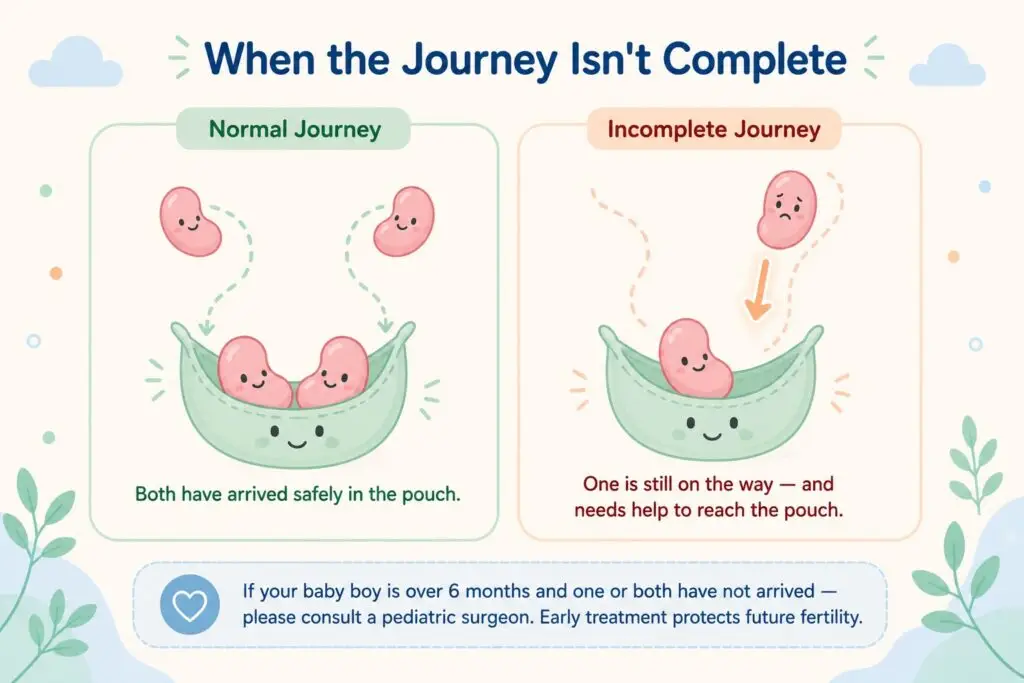
Imagine your newborn’s first checkup. The doctor says they could not feel one (or both) of your son’s testes in the scrotum (the skin bag below the penis). This is called an undescended testis. Or maybe you noticed it yourself during a bath. Either way, you probably went home with many questions and a lot of worry.
In this guide, I give you clear, honest answers. They are the same ones I give parents in my clinic every day.
What does “undescended testis” mean?
During pregnancy, the testes form inside the baby’s tummy. Normally, they move down into the scrotum before birth. But in some boys, one or both testes do not finish this journey. This happens in about 1–4% of full-term babies and 15–45% of babies born early (premature). Doctors call it undescended testis (cryptorchidism).
The good news is that in about one-third to one-half of cases, the testis comes down on its own within the first 3–6 months of life. But after 6 months, it is very unlikely to come down by itself.
Why does an undescended testis need treatment?
Many parents think this is a small issue. But an undescended testis is not just about looks. If you leave it untreated beyond the advised age:
- It may affect his chance to father children later. The testis needs the cool scrotum to make healthy sperm
- The risk of twisting (testicular torsion) goes up. The testis can twist and lose its blood supply. This is an emergency that needs surgery
- Higher risk of testis cancer as an adult. The overall risk is still low. But it is 2–10x higher than in a testis that came down normally (recent data)
- It can affect how the growing child feels about himself
The right age for undescended testis surgery
Experts across the world advise surgery between 6–18 months of age, ideally by 12 months.
This timing matters a lot because:
- Earlier surgery saves more of the testis and keeps it working better
- There is only a short time to protect his chance to have children later
- Anaesthesia and surgery are safe at this age when a trained team does them
Do not wait until school age or the teenage years. Many parents make this mistake because they do not know. And it has real effects.
How surgery for undescended testis is done
Doctors call the operation orchidopexy. The surgeon moves the testis from where it is (groin or tummy) down into the scrotum and fixes it there.
- Your child is fully asleep (general anaesthesia)
- It takes 30–60 minutes
- Most boys go home the same day (day-care)
- For a testis that no one can feel, the surgeon uses keyhole surgery (laparoscopy)
- Recovery is quick — most children are back to normal play within a week
What if no one can feel the undescended testis?
If you or your doctor cannot feel the testis during a check-up, it may be:
- Inside the tummy
- Absent (vanishing testis). The testis formed, but it lost its blood supply while the baby was growing. So it shrank away
The best way to find a testis inside the tummy is a keyhole camera check (diagnostic laparoscopy). Scans like ultrasound often miss it in these cases.
Questions parents often ask
“Can we just monitor and wait?”
Only if the child is under 6 months. After that, we do not advise just watching and waiting.
“Is one testis enough? Will my son be fertile?”
One healthy testis in the scrotum is generally enough for normal hormones and to father children.
“Will the surgery affect my son long-term?”
When a pediatric surgeon does this operation at the right age, the results are excellent. The risk of not treating is far greater than the risk of surgery.
Concerned about your son’s testis? Dr. Tanmay Motiwala is a pediatric surgeon and urologist trained at AIIMS, seeing patients in Raipur and Jagdalpur. Early assessment saves future complications. Book: +91 8319084711.
📋 This article is part of Dr. Motiwala’s Pediatric Urology in Raipur services — see the full range of conditions treated, what to expect, and when to see a pediatric surgeon.
Related conditions parents also read
- Hydrocele in baby boys
- Inguinal hernia in children (groin swelling)
- Testicular torsion (sudden testicle pain)
- Hypospadias in newborn boys
Worried about your child? Dr. Tanmay Motiwala consults in Raipur, Jagdalpur & Rajim. Book an appointment or call +91 83190 84711.
⚠️ Important Disclaimer: This article is provided purely for educational and awareness purposes. The information here is not a substitute for medical advice, diagnosis, or treatment, and should not be considered as an OPD or clinical consultation. Every child is different — symptoms that look the same may have different causes. If your child has any of the conditions or symptoms discussed, please consult your nearest qualified pediatric surgeon in person for an examination and personalised advice. In an emergency, go to the nearest hospital immediately.
Further reading for parents: Undescended testicles, NHS