 Dr. Tanmay Motiwala
Pediatric Surgeon, Raipur · Updated 30 Sep 2026 · 3 min read
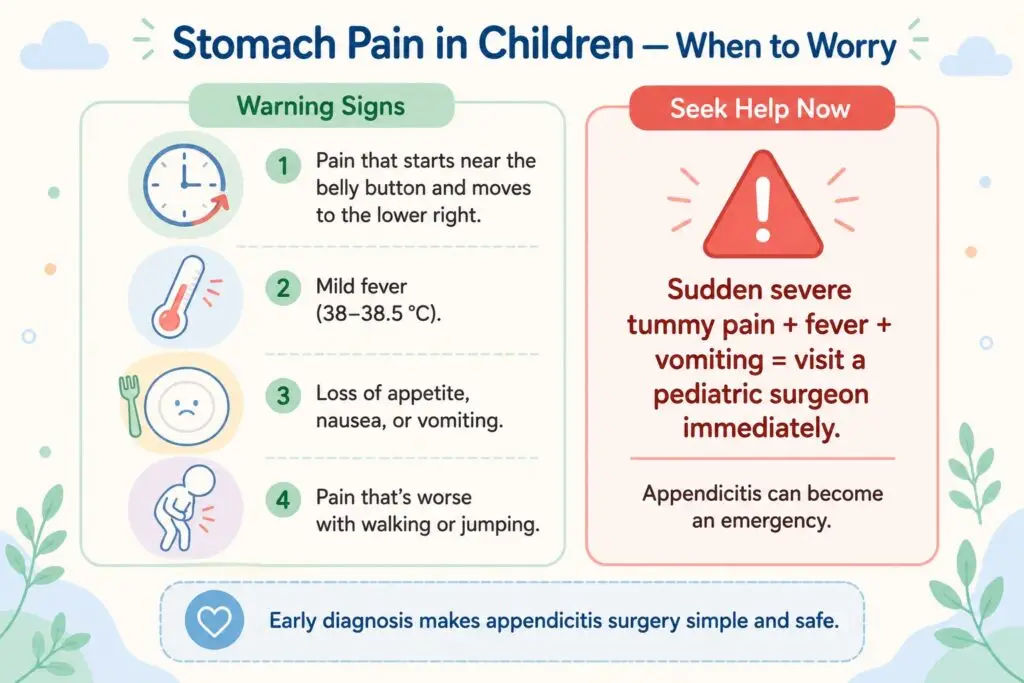
Stomach pain in children is common. But sometimes it is a sign of something serious, like appendicitis in children. Every parent should know how to spot it. This short guide shows you the signs, when to act fast, and what the surgery is like.
What is Appendicitis in Children?
The appendix is a small pouch on the large bowel. It is shaped like a finger. Appendicitis happens when it gets swollen or infected. Without treatment, the appendix can burst (rupture). Then a serious infection can spread in the tummy. This can put your child’s life at risk.
Signs of Appendicitis in Children
Watch for these signs:
- Pain that starts around the belly button, then moves to the lower right side of the tummy
- Fever (usually mild to moderate, not very high)
- Feeling sick and vomiting
- Not wanting to eat
- Pain that gets worse when your child walks or moves
- In younger children: crying that does not stop, not being able to stand straight, or not letting you touch the tummy
When is Appendicitis in Children an Emergency?
Does your child have bad tummy pain, high fever and vomiting together? Then do not wait. Go to a hospital right away. Do not wait for the pain to settle. A burst appendix is an emergency. You usually have 24–72 hours from when the signs start to act.
What Happens in the Surgery?
Removing the appendix (appendicectomy) is a very common urgent surgery in children. The surgeon uses keyhole surgery (laparoscopy) with 3 small cuts. Your child is fully asleep during it (general anaesthesia). It takes about 45–60 minutes. Most children stay in hospital for 1–3 days.
Getting Well After Surgery
Most children are fully well in 1–2 weeks after keyhole surgery. But if the appendix had already burst, healing may take longer. Your child can go back to school in about 2 weeks.
Trust your feelings as a parent. If tummy pain in your child does not go away, always get a doctor to check it. Dr. Tanmay Motiwala, a trained pediatric surgeon, manages both emergency and elective pediatric surgical cases in Raipur. Reach out if you are concerned.
📋 This article is part of Dr. Motiwala’s Pediatric General & Abdominal Surgery in Raipur services — see the full range of conditions treated, what to expect, and when to see a pediatric surgeon.
Related conditions parents also read
- Intussusception (sudden tummy pain + blood in stool)
- Pyloric stenosis (forceful vomiting in babies)
- Constipation in children
- Is surgery safe for my child? 7 questions parents ask
Worried about your child? Dr. Tanmay Motiwala consults in Raipur, Jagdalpur & Rajim. Book an appointment or call +91 83190 84711.
⚠️ Important Disclaimer: This article is provided purely for educational and awareness purposes. The information here is not a substitute for medical advice, diagnosis, or treatment, and should not be considered as an OPD or clinical consultation. Every child is different — symptoms that look the same may have different causes. If your child has any of the conditions or symptoms discussed, please consult your nearest qualified pediatric surgeon in person for an examination and personalised advice. In an emergency, go to the nearest hospital immediately.
Further reading for parents: Appendicitis, NHS
One Response