
 Dr. Tanmay Motiwala
Pediatric Surgeon, Raipur · Updated 20 Nov 2026 · 6 min read
हिंदी में पढ़ें: बच्चों में हर्निया
Quick answer: A soft lump in the groin or scrotum that grows when your child cries and goes away when they sleep is usually an inguinal hernia. It does not go away on its own. It needs a planned operation within 2 to 4 weeks. If the lump becomes hard, painful, or stays out, go to hospital the same day.
You are changing your baby’s diaper or giving your toddler a bath. You notice a soft lump in the groin or scrotum that was not there before. It might go away when your child lies down. It comes back when they cry or strain. That pattern is the typical sign of a hernia.
What is a groin hernia in children?
Before birth, a small tunnel runs from the tummy down into the groin. In boys, the testis moves down through it. The tunnel should close before or soon after birth. If it stays open, a loop of bowel or fat can slip into it. That bulge is an inguinal (groin) hernia.
- It is the most common type of hernia operation in children.
- It is more common in boys and in babies born early (premature).
- Girls get it too. In girls, an ovary can slip into the opening.
A hernia at the belly button is a different condition. Read umbilical hernia in babies. Most belly button hernias close on their own; groin hernias do not.
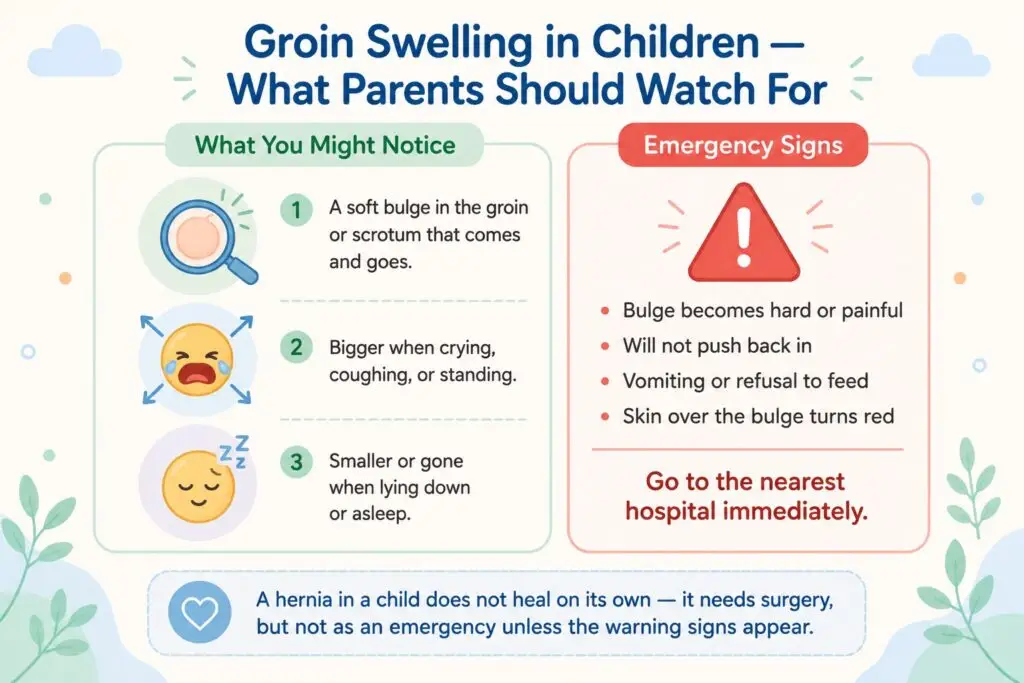
Signs of a groin hernia
- A soft lump in the groin, or a swelling of one side of the scrotum
- It gets bigger when your child cries, coughs or strains
- It gets smaller or disappears when your child is calm or asleep
- Usually no pain
Tip: Take a photo or short video when the lump is out. It often goes back in before the doctor sees it.
When is a hernia an emergency?
Sometimes the bowel gets stuck in the opening (an incarcerated hernia). This is an emergency. Go to hospital at once if:
- The lump becomes hard, tender, or does not go back in
- Your child cries without stopping and cannot be settled
- Your child starts vomiting
- The skin over the lump turns red or dark
Do not try to push a painful lump back in yourself.
Why should a groin hernia be operated soon?
A groin hernia never closes on its own. Babies have the highest risk of it getting stuck. In babies under 6 months, about 3 in 10 hernias get stuck if left alone. Waiting more than a month roughly doubles the chance of an emergency. So we plan surgery within 2 to 4 weeks of diagnosis.
- Premature babies in the NICU: the repair is usually done just before going home, once the baby weighs about 2 kg.
- Girls with an ovary in the hernia: the repair is done within a few days, because the ovary can twist.
- If a stuck hernia is pushed back by the doctor: the repair is done within 1 to 2 days.
How is it repaired?
Hernia repair is one of the most common operations in children. A pediatric surgeon closes the open tunnel. It is a day-care procedure; most children go home the same day.
At our centre in Raipur, we repair hernias with keyhole surgery (laparoscopy):
- Tiny cuts (3 to 5 mm)
- Less pain and faster return to play
- Small, neat scars
- The surgeon can look at the other side through the same camera. If the other side is also open, it can be closed in the same operation.
Hernia or hydrocele?
Both cause a swelling in the scrotum. The difference:
- A hernia goes back in when the child is calm, and comes out again with crying.
- A hydrocele is fluid around the testis. It usually stays the same size and does not go back in. Many hydroceles in babies go away on their own.
Read hydrocele in baby boys. A pediatric surgeon can tell the two apart by examining your child.
Frequently asked questions
No. The opening is there from birth. Crying only pushes the bowel into the opening, so the lump shows.
A groin hernia does not close on its own. A belly button hernia often does.
No. Belts and trusses do not stop a hernia getting stuck. They can hurt the cord and the testis.
Age is not a reason to wait. We repair it soon after diagnosis, even in small babies.
A pediatric anaesthetist gives it. Babies born early who have surgery before about 50 to 60 weeks after conception stay one night for breathing checks.
Rarely. It comes back in about 1 in 100 children.
The tube that carries sperm lies right next to the hernia. Injury to it is rare, well under 1 in 100 operations, and the risk is higher in emergency repairs. Planned early repair by a pediatric surgeon keeps the risk lowest.
Most children are back to normal play in a few days. Your surgeon will tell you about bathing and wound care.
What to do if you think your child has a hernia
- Take a photo or video of the lump.
- See a pediatric surgeon to confirm it.
- Go to hospital at once if the lump is hard, painful or stuck.
Dr. Tanmay Motiwala sees patients in Raipur, Jagdalpur, and Rajim. If you’ve noticed a swelling in your child’s groin or belly button, book an appointment at +91 8319084711.
📋 This article is part of Dr. Motiwala’s Pediatric General & Abdominal Surgery in Raipur services — see the full range of conditions treated, what to expect, and when to see a pediatric surgeon.
Related conditions parents also read
- Umbilical hernia in babies (belly button bulge)
- Hydrocele in baby boys (swollen scrotum)
- Undescended testis
- Testicular torsion (sudden scrotal pain)
- Is surgery safe for my child? 7 questions parents ask
Worried about your child? Dr. Tanmay Motiwala consults in Raipur, Jagdalpur & Rajim. Book an appointment or call +91 83190 84711.
⚠️ Important Disclaimer: This article is provided purely for educational and awareness purposes. The information here is not a substitute for medical advice, diagnosis, or treatment, and should not be considered as an OPD or clinical consultation. Every child is different — symptoms that look the same may have different causes. If your child has any of the conditions or symptoms discussed, please consult your nearest qualified pediatric surgeon in person for an examination and personalised advice. In an emergency, go to the nearest hospital immediately.
Further reading for parents: Inguinal hernia in babies and children, Cleveland Clinic