Your child strains on the potty, and afterwards you see a red or pink, moist lump coming out of the bottom. It can look alarming — like a small tube or a rosette of soft flesh at the anus. Often it slips back in by itself, or you gently push it back, and your child seems otherwise well. This is rectal prolapse: the lining of the lowest part of the bowel turning outward through the anus during a strain. This article explains what it is, why it happens most in toddlers, one important test not to skip, and the reassuring fact that most children grow out of it without surgery.
What Is Rectal Prolapse?
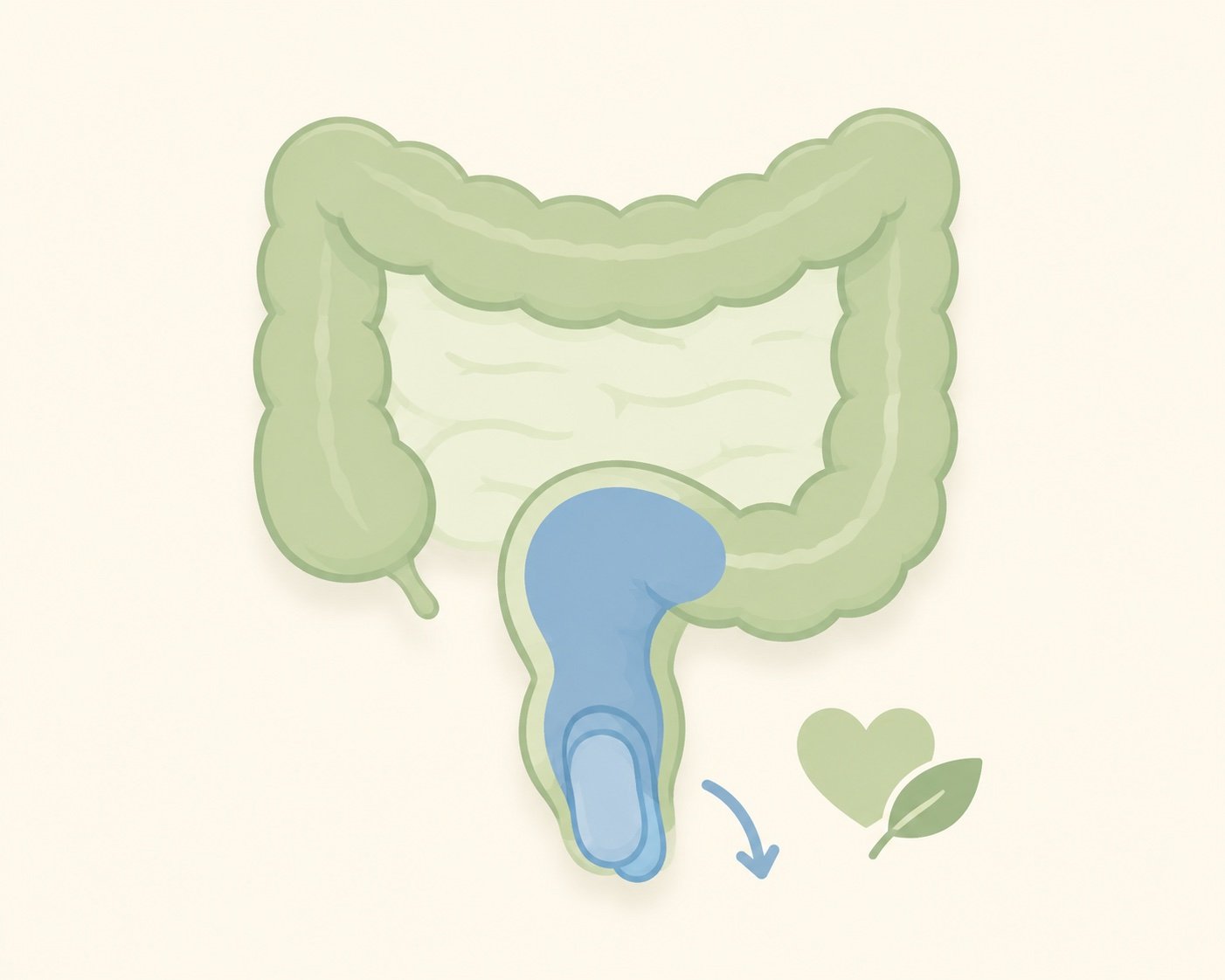
The rectum is the last part of the bowel, just inside the anus. In rectal prolapse, part of it is pushed out through the anus, usually while your child strains to pass a hard stool. What you see is soft, red or pink, and moist. It most often appears during or just after pooing and then goes back in — either on its own or with a gentle push. Between episodes the bottom usually looks completely normal.
Partial and Complete Prolapse
There are two kinds, and knowing the difference helps. In a partial prolapse, only the inner lining comes out — a small amount, usually about 1 to 3 cm. In a complete prolapse, the full thickness of the rectal wall turns out, and it is larger — more than 5 cm. Most young children have the partial type. Either way, the underlying reason and the first line of care are usually the same.
Why It Happens — Mostly in Toddlers
Rectal prolapse peaks between the ages of one and three years, and in most children there is no serious underlying disease — doctors call this “idiopathic,” meaning it happens on its own. At this age the tissues that hold the rectum in place are naturally more relaxed, and repeated straining — usually from constipation and hard stools — pushes the lining out. This is why treating any constipation and easing the straining is such an important part of care.
One Test Not to Skip — Checking for Cystic Fibrosis
This is the single most important point for parents. Although most prolapse is harmless, it can occasionally be the first outward sign of cystic fibrosis, a condition affecting the lungs and digestion. In fact, more than 20 out of every 100 children with cystic fibrosis develop rectal prolapse at some point. Because of this, a surgeon will usually recommend a simple check for cystic fibrosis in any child whose prolapse has no obvious cause. It is a quick check that gives real peace of mind.
What to Do When It Comes Out
In the moment, stay calm — it is not usually painful or dangerous. If it does not slip back on its own, you can gently guide it back in with a clean, lubricated finger, with your child lying down. The main day-to-day treatment is aimed at the cause: softening the stool and stopping the straining, so keep your child well hydrated, add fibre, and use any stool softener your doctor advises. Cutting down long sits on the potty helps too.
The Reassuring Part — Most Settle Without Surgery
Here is the good news. With gentle reduction and treatment of constipation, most children get better on their own, usually within about 12 to 18 months, as they grow and their tissues firm up. Surgery is not the first step and is not needed for most children.
When Surgery Is Needed
An operation is kept for the smaller number of children whose prolapse keeps coming back despite good treatment, or who are older than about four years. When surgery is needed, a common modern approach is a keyhole (laparoscopic) operation that gently fixes the rectum back into its proper position (called rectopexy). It is reserved for the cases that do not settle with the simple measures above.
What Every Parent Must Know
- Rectal prolapse is the lining of the bowel turning out through the anus during a strain — it looks alarming but is usually not dangerous.
- It peaks between ages one and three, and in most children there is no serious underlying disease.
- The usual driver is constipation and straining — treating that is the heart of care.
- Ask about a check for cystic fibrosis: more than 20 out of 100 children with cystic fibrosis get rectal prolapse, so it must be ruled out.
- Most children settle without surgery, usually within 12 to 18 months.
- Surgery (a keyhole rectopexy) is kept for prolapse that keeps returning or in children older than about four.
When to See a Doctor
See a pediatric surgeon if the prolapse happens repeatedly, will not go back in easily, bleeds, or if your child is in pain. It is also worth a visit simply to confirm the diagnosis, arrange a check for cystic fibrosis, and get a clear stool-softening plan. Early, simple care usually settles the problem and avoids the need for an operation.
Dr. Tanmay Motiwala is a pediatric surgeon in Raipur, Chhattisgarh, trained at AIIMS Jodhpur. He assesses rectal prolapse and bowel problems in children from across Chhattisgarh and central India, treating the cause first and reserving surgery for the few children who truly need it.
Related reading:
- Constipation in Children: Causes, Treatment & When to See a Pediatric Surgeon
- My Child Cries and Bleeds When Passing Hard Stools — Is It an Anal Fissure?
- Baby Not Passing Stool Since Birth? It Could Be Hirschsprung Disease
📋 This article is part of Dr. Motiwala’s Pediatric Colorectal & Anorectal Surgery in Raipur services — see the full range of conditions treated, what to expect, and when to see a pediatric surgeon.
Related conditions parents also read
- Constipation in children (causes and treatment)
- Crying and bleeding when passing hard stools (anal fissure)
- Baby not passing stool since birth (Hirschsprung disease)
Worried about your child? Dr. Tanmay Motiwala consults in Raipur, Jagdalpur & Rajim. Book an appointment or call +91 83190 84711.
⚠️ Important Disclaimer: This article is for general information and educational purposes only. It is not a substitute for professional medical advice, diagnosis, or treatment. Every child’s condition is different — facts, prognosis, and management can vary significantly from case to case. Please consult a qualified pediatric surgeon for advice specific to your child.
Sources: Coran’s Pediatric Surgery (7th ed), Ch. 104 (Other Disorders of the Anus and Rectum, Anorectal Function), Rintala & Pakarinen.