 Dr. Tanmay Motiwala
Pediatric Surgeon, Raipur · Updated 1 Oct 2026 · 7 min read
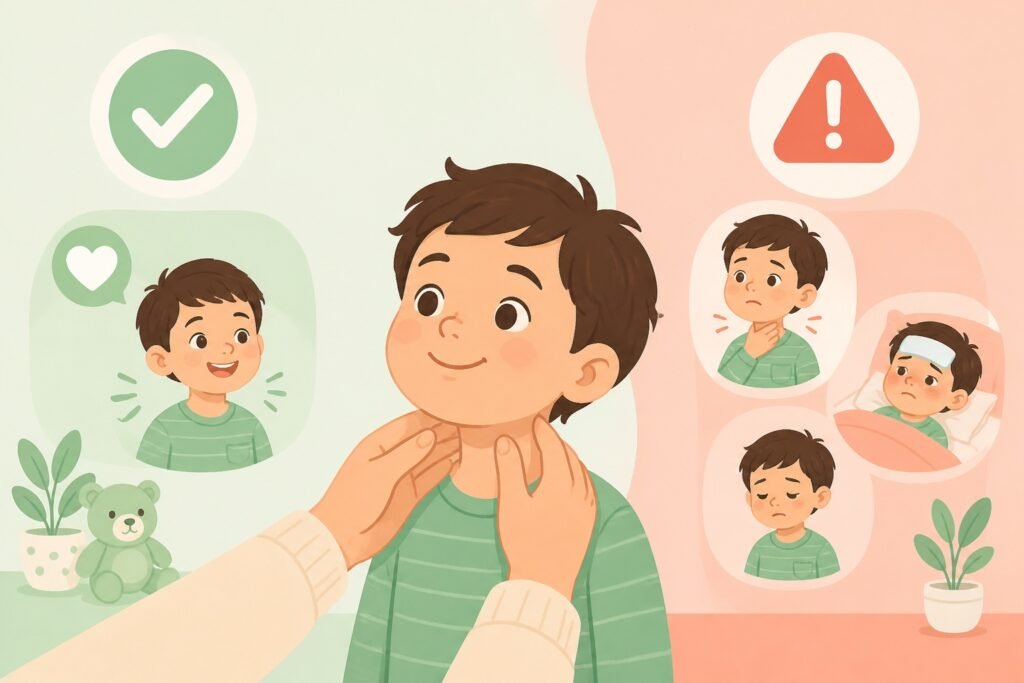
You are drying your child after a bath, or stroking their hair, when your fingers find it: a lump on the side or front of the neck. Perhaps it seemed to appear suddenly, and your child feels no pain. In that instant, most parents fear the worst. A neck lump in children is one of the most common reasons a worried mother or father comes to see me.
Here is the reassuring truth first: in children, the great majority of neck lumps are harmless. Most are simply glands that swell in reaction to a common infection. In fact, doctors can feel small neck glands in many completely healthy children. But a few lumps do need a surgeon, and a small number are serious. This article will help you tell the difference.
Below are the common causes, the lumps that need treatment, and, most importantly, the warning signs that mean you should get a lump checked without delay.
Why a Neck Lump in Children Is So Common
The neck is full of lymph nodes. These small glands act as the body’s infection filters. In children they swell very easily, because a child’s body meets so many new infections for the first time.
Small, soft neck glands that move under the skin are present in a very large share of perfectly healthy children. Some counts put it at roughly a third to a half of them. So a small neck lump in children is usually a sign of a busy, working immune system, not of disease.
Common, Harmless Causes: A Soft Lump That Moves
By far the most common neck lump is a reactive (swollen) lymph gland. It typically:
- Comes up over a few days, during or just after a cold, sore throat, ear infection or skin infection.
- Is tender, soft and moves under the skin when you press it.
- Slowly settles over a few weeks as the infection clears.
Viruses cause most of these infections, and they clear on their own. Sometimes bacteria infect a gland, and it turns hot, red and very tender. Then a course of antibiotics usually settles it. This kind of lump is common and rarely needs surgery.
When a Neck Lump in Children Needs a Surgeon
Some neck lumps are not glands at all. They are small cysts left over from how the neck forms before birth. They are harmless, but they tend to grow or get infected, so a surgeon usually removes them:
- Thyroglossal duct cyst: a smooth lump in the middle (midline) of the neck. Its giveaway sign is that it moves upward when the child swallows or sticks out the tongue. Before surgery, an ultrasound scan is essential to confirm the thyroid gland sits in its normal place. The operation (a Sistrunk procedure) removes the cyst, its track and a small piece of the hyoid bone, so it does not come back.
- Branchial cleft cyst: a smooth lump along the side of the neck, again from development before birth. It can become infected. The surgeon removes it once any infection has fully settled.
- Dermoid cyst: a midline lump that, unlike a thyroglossal cyst, does not move when the child pokes the tongue out.
- A gland infection that won’t clear (atypical, or non-tuberculous, mycobacteria). This usually affects children aged 1 to 5. It is a slowly growing, painless lump with thin, pink-purple skin over it. Normal antibiotics do not help. The best treatment is to remove it completely, which cures around 9 in 10. The surgeon should not simply cut it open or drain it, as that tends to leave a track that keeps leaking.
One important rule: a surgeon never removes a lump while it is acutely infected. First, antibiotics settle the infection (with a needle drainage if needed). Then the surgeon removes the cyst later, as a planned operation. Operating through hot, swollen tissue makes surgery harder and makes the lump more likely to come back.
Red Flags: When to Get a Neck Lump in Children Checked Now
See a doctor promptly, rather than simply watching, if a neck lump is:
- Hard, or fixed, so it does not move freely under the skin.
- Sitting just above the collarbone, or at the inner elbow. Glands in these spots are never simply “normal” and always deserve a look.
- Getting steadily bigger, or still present after about 4 to 6 weeks.
- Larger than about 2 to 3 cm (roughly the size of a grape or bigger).
- Coming with fever that will not settle, weight loss, drenching night sweats, or a swollen tummy (a big liver or spleen).
These features prompt a doctor to arrange tests. Sometimes this includes a biopsy, where the surgeon removes the gland so a specialist can examine it under the microscope. The aim is to rule out cancers of the lymph glands (lymphoma) or blood (leukaemia).
Being Honest About the Serious Causes
Most neck lumps are not cancer, and it is right to feel reassured. But it would be wrong to pretend a lump never is. Surgeons remove and test only the more worrying lumps. Among these, roughly 1 in 8 to 1 in 4 turn out to be cancer. Most often it is lymphoma or leukaemia, or the spread of another childhood tumour.
That figure is exactly why a doctor should see any lump with the red-flag features above quickly. Do not watch it at home for months. Doctors can treat a serious lump far more easily when they catch it early. Reassurance and vigilance are not opposites. The goal is to relax about the common, harmless lumps while acting fast on the few that are not.
What Every Parent Must Know
- Most neck lumps in children are harmless glands that swell with a nearby infection and settle within a few weeks.
- A midline lump that moves when the child sticks out the tongue is likely a thyroglossal cyst. A lump on the side may be a branchial cyst. A surgeon removes both.
- Get any lump checked quickly if it is hard, fixed, above the collarbone, growing, still there after 4–6 weeks, or comes with fever, weight loss or night sweats.
- A surgeon does not remove a lump while it is actively infected. Treat the infection first, and plan surgery later.
When to See a Pediatric Surgeon
You can usually watch a soft, tender lump that appears with a cold and settles in a couple of weeks. But have a neck lump checked if it is not settling, is growing, feels hard or fixed, or sits above the collarbone. The same applies if your child has fever, weight loss or night sweats. Also, any midline lump that moves with the tongue is worth a planned surgical opinion.
Dr. Tanmay Motiwala is a pediatric surgeon in Raipur, Chhattisgarh, trained at AIIMS Jodhpur. He evaluates neck lumps, cysts and swollen glands in children from across Chhattisgarh and central India, and can advise whether a lump simply needs watching, antibiotics, or planned surgery.
Related reading:
- The Red Birthmark on My Baby Is Growing — Should I Worry?
- Hydrocele in Baby Boys: Why the Scrotum Looks Swollen — and When to Worry
- Umbilical Hernia in Babies: Why the Belly Button Pops Out — and Why a Coin Won’t Help
📋 This article is part of Dr. Motiwala’s Pediatric General & Abdominal Surgery in Raipur services — see the full range of conditions treated, what to expect, and when to see a pediatric surgeon.
Related conditions parents also read
- Infantile haemangioma (the red “strawberry” birthmark)
- Hydrocele in baby boys (swelling in the scrotum)
- Umbilical hernia (why the belly button pops out)
Need a pediatric surgical consultation in Chhattisgarh? View current OPD locations and timings in Raipur and Jagdalpur, or book an appointment. Families from Bhilai, Durg, Bilaspur and other cities can call ahead to plan the most suitable consultation location.
⚠️ Important Disclaimer: This article is for general information and educational purposes only. It is not a substitute for professional medical advice, diagnosis, or treatment. Every child’s condition is different — facts, prognosis, and management can vary significantly from case to case. Please consult a qualified pediatric surgeon for advice specific to your child.
Sources: Coran’s Pediatric Surgery (7th ed), Ch. 57 (Lymph Node Disorders) & Ch. 59 (Neck Cysts and Sinuses); Rob & Smith Operative Pediatric Surgery (7th ed). Further reading for parents: Swollen glands, NHS.