
 Dr. Tanmay Motiwala
Pediatric Surgeon, Raipur · Updated 30 Sep 2026 · 6 min read
You change your toddler’s nappy, or your older child calls you to the toilet. And there it is: a large amount of dark red or maroon blood in the stool. The scary part is that your child seems well and is not in pain. Few things frighten a parent more, and it is a common reason families come to a pediatric surgeon. One leading cause of this picture is a Meckel diverticulum.
A Meckel diverticulum (also called Meckel’s diverticulum) is a small, leftover pouch of bowel. It can cause a lot of blood, but no pain. In this article I explain what it is, why it bleeds without hurting, how we find it, and how we treat it.
What a Meckel Diverticulum Is
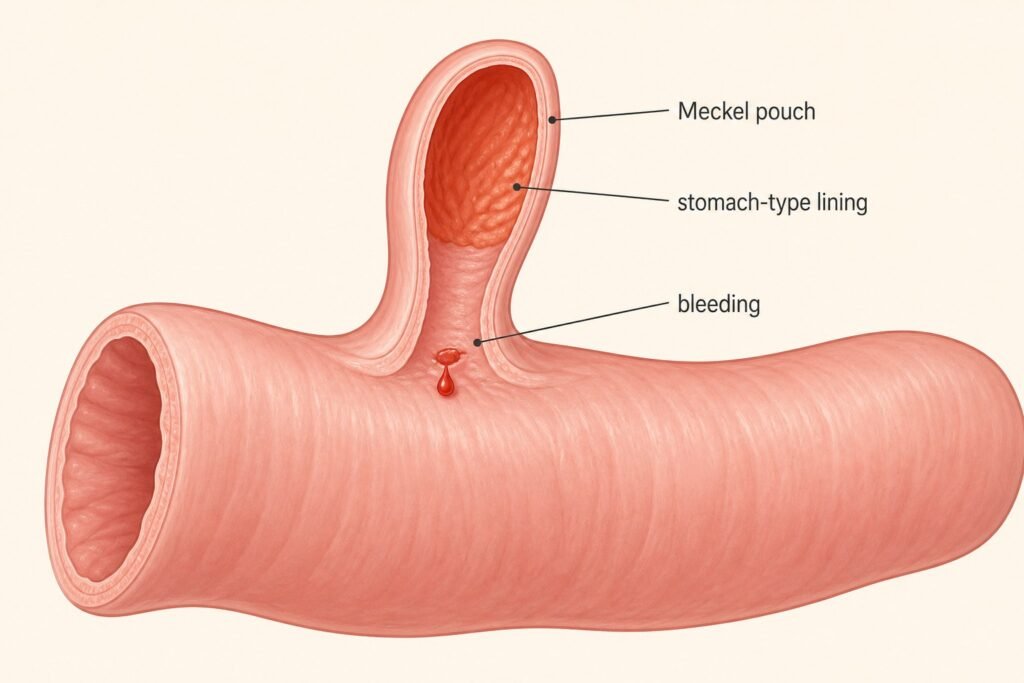
Before birth, a thin tube joins the baby’s gut to the umbilical cord. Normally this tube disappears completely. But in some children a small part of it stays behind. It forms a little pouch on the small intestine. That pouch is a Meckel diverticulum.
It is surprisingly common. Roughly 2 in every 100 people have one. The good news for parents is that the great majority never cause any trouble at all. Most people who have one never know. Only a few ever get symptoms.
Why a Meckel Diverticulum Bleeds Without Pain
Here is the key part. About 8 in 10 of the pouches that bleed contain a patch of stomach-type lining. This lining does what stomach lining does: it makes acid. But the small bowel next to it cannot cope with acid. So the acid burns a small sore (ulcer) in the nearby normal bowel, and that ulcer bleeds.
This is an acid ulcer. It is not a tear, an infection, or a squeezing blockage. So it usually causes painless bleeding, and that is the big clue. An anal fissure hurts, and a tummy bug makes a child unwell. A bleeding Meckel diverticulum, however, often causes a large, painless brick-red or maroon bleed in a happy child. In fact, it causes close to half of all significant lower-bowel bleeding in children.
Other Ways It Can Show Up
Bleeding is the most common sign. But the pouch does not always stay quiet and painless. It can also cause:
- A blockage (obstruction). The pouch can make the bowel slide into itself like a telescope (intussusception) or twist (volvulus). This causes colicky pain, vomiting and a swollen tummy.
- Inflammation that looks like appendicitis. An inflamed pouch causes right-sided tummy pain and fever. Surgeons often find it by surprise when the appendix turns out to be normal at operation.
So the headline is “painless bleeding”. Yet a Meckel diverticulum can also make a child ill and in pain. That is one reason it needs a surgeon’s check, not watchful waiting at home.
Tests to Find a Meckel Diverticulum
When the child has painless bleeding, the best test is a special scan called a Meckel’s scan (technetium pertechnetate scan). The child receives a small, safe amount of tracer. Stomach-type lining picks up this tracer, so the scan lights up the pouch that causes the trouble.
If a child has bled heavily, the first priority is the child, not the scan. The team starts a drip and gives a blood transfusion if needed to make the child stable. For a blockage or an appendicitis-like picture, we use ultrasound, other scans or an operation to make the diagnosis instead.
Surgery for a Meckel Diverticulum
If a Meckel diverticulum has caused symptoms, the surgeon removes it with an operation, often by keyhole surgery (laparoscopy). One detail matters here. For a bleeding pouch, the surgeon usually removes it together with a short piece of the bowel next to it. Why? Because the bleeding ulcer sits in that nearby bowel, not in the pouch itself. Taking out only the pouch could leave the ulcer behind.
Next, the surgeon joins the two healthy ends of bowel. Recovery is usually quick, and most children need only a short hospital stay. The operation generally cures the problem. Serious complications are uncommon (about 5 to 10 in 100 when surgery is done because of symptoms).
An Honest Word for Parents
The reassuring truth is that most treated children make a full recovery and have no further problem. But here is my honest warning. A bleed from this pouch can be large. It can leave a child pale, tired and short of blood, so do not watch it at home. A lot of blood in a child’s stool is never normal. It always needs a prompt medical check, even if the child seems fine. In fact, that is when it matters most.
What Every Parent Must Know
- A large, painless, dark-red or maroon bleed in a well child is a classic sign of a bleeding Meckel diverticulum.
- It bleeds because stomach-type lining makes acid. The acid causes an ulcer in the nearby bowel, which is why it usually does not hurt.
- Doctors find it with a Meckel’s scan. The surgeon treats it with an operation (often keyhole) to remove the pouch and a small piece of nearby bowel.
- Any significant blood in a child’s stool needs a prompt check. Do not wait, even if there is no pain and the child looks well.
When to See a Pediatric Surgeon
Take your child to a doctor urgently if they pass a large amount of blood in the stool. Go urgently too if they look pale or very tired after bleeding, or if bleeding comes with colicky pain, vomiting or a swollen tummy. Right-sided tummy pain with fever also needs a prompt check. A pediatric surgeon can arrange the right test and decide whether your child needs an operation.
Dr. Tanmay Motiwala is a pediatric surgeon in Raipur, Chhattisgarh, trained at AIIMS Jodhpur. He evaluates bleeding, abdominal pain and bowel problems in children from across Chhattisgarh and central India, and can advise whether a child needs a scan, admission, or surgery.
Related reading:
- My Baby Has Sudden, Severe Stomach Pain and Passed Blood in the Stool — What Is Intussusception?
- My Child Cries and Bleeds When Passing Hard Stools — Is It an Anal Fissure?
- Appendicitis in Children: When Stomach Pain Needs Surgery
📋 This article is part of Dr. Motiwala’s Pediatric General & Abdominal Surgery in Raipur services — see the full range of conditions treated, what to expect, and when to see a pediatric surgeon.
Related conditions parents also read
- Intussusception (sudden severe pain and blood in the stool)
- Anal fissure (pain and bleeding when passing hard stools)
- Appendicitis (when stomach pain needs surgery)
Worried about your child? Dr. Tanmay Motiwala consults in Raipur, Jagdalpur & Rajim. Book an appointment or call +91 83190 84711.
⚠️ Important Disclaimer: This article is for general information and educational purposes only. It is not a substitute for professional medical advice, diagnosis, or treatment. Every child’s condition is different — facts, prognosis, and management can vary significantly from case to case. Please consult a qualified pediatric surgeon for advice specific to your child.
Sources: Coran’s Pediatric Surgery (7th ed), Ch. 84 (Meckel’s Diverticulum); Rob & Smith Operative Pediatric Surgery (7th ed). Further reading for parents: Meckel’s diverticulum, Great Ormond Street Hospital.