
 Dr. Tanmay Motiwala
Pediatric Surgeon, Raipur · Updated 30 Sep 2026 · 7 min read
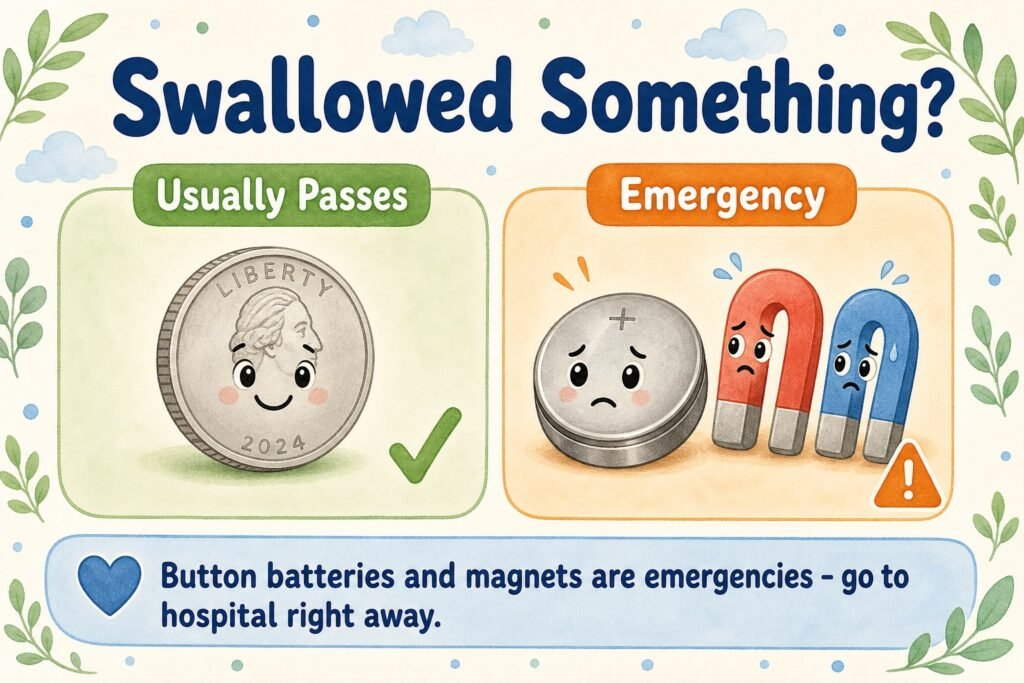
Few things frighten a parent faster than learning your child swallowed an object: a coin from the table, a bead, a button off a shirt. The reassuring truth is that most swallowed objects that reach the stomach pass out on their own within a few days. Usually you need to do nothing but watch the nappy. But a few objects are truly dangerous. With two of them, button batteries and magnets, every minute counts. In this article I explain which is which.
Child Swallowed an Object? Most Pass on Their Own
Sometimes a smooth object, like a small coin, a bead or a fruit seed, goes past the food pipe and into the stomach. Once it gets there, it almost always travels the rest of the way through the gut. It then comes out in the stool without any treatment. The standard approach for these is simply watchful waiting and reassurance. Feed your child as normal, and look in the nappy over the next few days to confirm it has passed.
You do not need to search every nappy anxiously, give laxatives, or try to make your child vomit. In fact, forcing vomiting can do harm, and doctors advise against it. Only two questions really matter: what did the child swallow, and is the child comfortable? If the answer to “what” is a battery or a magnet, or if the child is uncomfortable, everything changes.
The One That Cannot Wait: Button Batteries
A button (disc) battery is the shiny, coin-shaped battery inside remotes, toys, hearing aids, watches and car keys. If one gets stuck in the food pipe (oesophagus), it is a true emergency. It does not need to leak or break to cause harm. As it sits against the wall of the food pipe, it makes a small electric current and releases a strong alkali. This burns the tissue with frightening speed.
How fast? Injury to the inner lining can begin within one hour, and damage through the full thickness of the muscle wall can occur within about four hours. Larger 3-volt lithium batteries do more damage than the older 1.5-volt type. If the battery stays in place, the burn can eat through into the windpipe or a major blood vessel behind the food pipe. That can cause catastrophic bleeding or a severe chest infection (mediastinitis).
So if you know, or even suspect, that your child swallowed a button battery, go to the nearest emergency department immediately. Do not wait for symptoms, and do not wait until morning. Do not try to make the child vomit, and do not try to remove anything yourself. Bring the device the battery came from, or an identical battery, so the team knows the exact size. An X-ray shows whether it is a battery and where it sits. If it is in the food pipe, the team removes it urgently.
Two or More Magnets: Also an Emergency
Small, powerful rare-earth magnets (the tiny silver balls in desk toys and some building sets) are the other object that turns a swallow into a surgical problem. A single magnet usually passes harmlessly. The danger is two or more magnets, or one magnet plus another metal object.
The magnets move through different loops of bowel. Then they pull on each other across the bowel walls and clamp together, trapping the bowel wall in between. The magnets slowly crush that trapped tissue until it dies. This can cause a hole (perforation), an abnormal link between two loops of gut (fistula), a blockage, or a twist. So when a child swallows several magnets, they usually need prompt removal, often by an operation, not just watching. Treat “more than one magnet” as an urgent hospital visit, even if your child seems perfectly well.
Coins: the Commonest, Usually Simpler
Coins are by far the object children swallow most often. In one large hospital series they made up about 76% of all food-pipe foreign bodies. A coin that has reached the stomach will usually pass on its own. The problem coin is the one that gets stuck in the food pipe. An object that stays in the oesophagus carries roughly a 9% risk of a complication, such as a tear or breathing it into the lungs (aspiration). So doctors generally remove a coin stuck there rather than leave it.
Some signs tell you that something is stuck in the food pipe rather than safely in the stomach. Watch for drooling, refusing to swallow, or discomfort in the throat or chest. A child with those signs needs a doctor the same day.
Child Swallowed a Sharp or Long Object?
Pins, needles, open safety pins, screws, toothpicks and long objects are the other group you should not simply watch. A sharp point can catch and pierce the bowel wall. If your child has swallowed anything sharp, get them checked rather than waiting for it to pass.
Red Flags After a Child Swallowed an Object
Whatever your child swallowed, get emergency care straight away if you see any of these:
- Choking, gagging, severe coughing, noisy breathing, or trouble breathing, and above all a child who cannot speak, cry or breathe. This suggests a blocked airway, so call for emergency help.
- Drooling and not being able to swallow, or pain in the throat or chest. This suggests something is stuck in the food pipe.
- Vomiting, refusing to eat or drink, or blood in the spit or stool.
- Any button battery or more than one magnet: go at once, even if your child seems completely fine. With these two, waiting for symptoms is exactly the mistake to avoid.
When to See a Pediatric Surgeon
A doctor should promptly check any child who has swallowed a battery, a magnet or a sharp object. The same goes for a child with drooling, pain or trouble swallowing after swallowing anything. It helps a lot to bring the packaging or an identical item, so the team knows the exact size and type. A simple X-ray finds the object and shows whether it is a coin or a battery. When removal is needed, the team does it in a controlled setting where the airway is protected.
Dr. Tanmay Motiwala is a pediatric surgeon in Raipur, Chhattisgarh, trained at AIIMS Jodhpur. He manages swallowed foreign bodies and paediatric surgical emergencies in children from across Chhattisgarh and central India. If your child has swallowed a button battery or magnets, treat it as an emergency and go to the nearest hospital right away.
📋 This article is part of Dr. Motiwala’s Pediatric General & Abdominal Surgery in Raipur services — see the full range of conditions treated, what to expect, and when to see a pediatric surgeon.
Related conditions parents also read
- Appendicitis in children (when stomach pain needs surgery)
- Intussusception (sudden tummy pain and blood in the stool)
- Common pediatric surgical conditions every parent should know
Worried about your child? Dr. Tanmay Motiwala consults in Raipur, Jagdalpur & Rajim. Book an appointment or call +91 83190 84711.
⚠️ Important Disclaimer: This article is for general information and educational purposes only. It is not a substitute for professional medical advice, diagnosis, or treatment. Every child’s condition is different — facts, prognosis, and management can vary significantly from case to case. Please consult a qualified pediatric surgeon for advice specific to your child.
Sources: Coran’s Pediatric Surgery (7th ed); Rob & Smith Operative Pediatric Surgery (7th ed). Further reading for parents: The Risks to Young Children from Swallowed Objects, Children’s Hospital of Philadelphia.