 Dr. Tanmay Motiwala
Pediatric Surgeon, Raipur · Updated 30 Sep 2026 · 7 min read
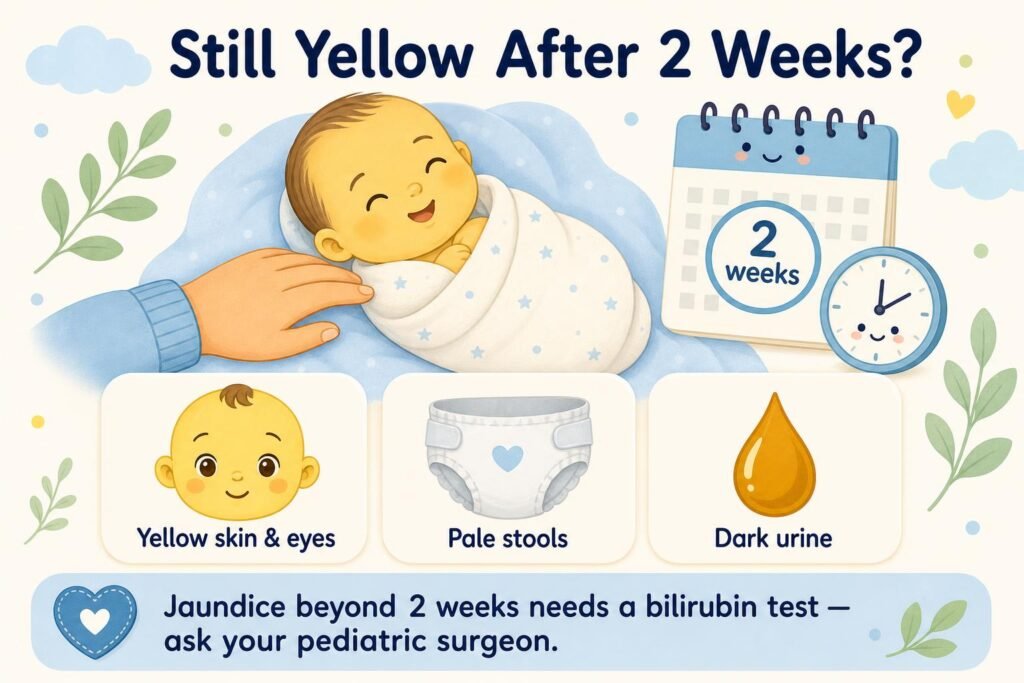
Most newborns turn a little yellow in the first week of life. Usually it is harmless and fades on its own. But sometimes the yellow does not go away. A few of these babies have a serious, hidden liver problem called biliary atresia, which is silently getting worse every week.
There is one rule every parent and doctor should hold on to:
> Any baby who is still jaundiced (yellow) after 2 weeks of age must have a blood test to check the type of bilirubin — without delay.
That one test can mean the difference between saving a baby’s own liver and needing a transplant. In this article I explain why.
Two Very Different Kinds of Newborn Jaundice
Jaundice means the skin and the whites of the eyes turn yellow. A yellow pigment called bilirubin builds up in the blood and causes it. There are two completely different types, and they are not the same problem at all:
- “Indirect” (unconjugated) jaundice: the common, usually harmless kind. It appears in the first days of life. Normal newborn jaundice and breast-milk jaundice are this kind. It almost always settles by itself.
- “Direct” (conjugated) jaundice: the dangerous kind. Here the liver gets bilirubin ready to leave the body, but it cannot get out. The drainage pipes (bile ducts) are blocked. This type is never normal in a baby, at any age.
A simple blood test, called a fractionated or split bilirubin, tells the two apart. That is why a baby still yellow at 2 weeks needs this test, not just reassurance.
The Condition We Are Most Afraid of: Biliary Atresia
In a young baby, the main cause of the dangerous (conjugated) kind is biliary atresia.
The bile ducts are tiny pipes that carry bile from the liver to the gut. In biliary atresia, these pipes become swollen, scarred and blocked, usually in the first weeks of life. Bile cannot drain, so it backs up and damages the liver. Without treatment, this leads to scarring of the liver (cirrhosis) and, in the end, liver failure.
It is not common. It affects roughly 1 in 10,000 to 1 in 18,000 babies, and it is a bit more common in Asian countries. But it is the single most common reason a child ever needs a liver transplant. That is exactly why doctors must never miss it.
Three Signs of Biliary Atresia Parents Should Watch For
Biliary atresia hides inside a baby who looks healthy, feeds well and grows. The warning signs are:
1. Jaundice that lasts beyond 2 weeks of age. The skin and the whites of the eyes stay yellow instead of clearing.
2. Pale, clay-coloured or chalky-white stools. This is the most important sign. When bile cannot reach the gut, the stool loses its normal yellow-green colour. It turns pale, putty-like or white. Early on, the stools can look normal in up to half of babies, so this change can come slowly. Keep checking the nappy colour.
3. Dark urine. A newborn’s urine should be almost colourless. Watch for urine that stays dark yellow or brown and stains the nappy. This is a warning sign, because the kidneys are now passing out the trapped bilirubin instead.
A doctor may also feel that the liver is big and firm. If you ever see pale stools and dark urine together in a young baby, treat it as urgent.
Biliary Atresia Surgery: Why Timing Is Everything
Surgeons treat biliary atresia with an operation called the Kasai procedure (hepatic portoenterostomy). The surgeon removes the scarred, blocked ducts. Then the surgeon joins a loop of bowel right onto the liver, so bile can drain again.
The Kasai operation is not a cure. It gets bile flowing again and protects the baby’s own liver for as long as it can. And here is the key part: it works far better the earlier the surgeon does it, before the liver is badly scarred.
For many years, doctors taught a strict deadline of 60 days of age. We now know the picture is a little more forgiving. For typical biliary atresia, the chance of clearing the jaundice holds up fairly well until around 8 to 12 weeks. After that, results clearly get worse. But the liver scars a little more every single week. So the goal has not really changed: diagnose early and operate as early as possible, ideally well before 3 months of age. A baby diagnosed at 3 weeks does far better than one diagnosed at 3 months.
This is the whole reason for the 2-week rule. Waiting a few weeks to test a yellow baby can cost that baby a working liver.
What Happens After a Kasai Operation: The Honest Picture
Parents deserve the truth so they can plan, not false comfort.
- After a Kasai, bile starts draining in about two-thirds of babies. The jaundice fully clears in roughly 55–60%.
- Even when the operation goes well, the liver often keeps getting worse. Over time, about 70–80% of children with biliary atresia need a liver transplant. For many, the Kasai buys precious years of growth first.
- Roughly 45–50% of children are alive with their own (native) liver at 5 years. This falls to around 30–45% at 10 years. Some children do reach adulthood with their own liver, but they usually need careful check-ups for life.
I do not share these numbers to frighten you. I share them to show why early diagnosis matters so much. A baby who has surgery early, before the liver is badly scarred, has the best chance in every one of these numbers. Also, children who need a transplant today have excellent long-term results.
What Every Parent Must Know
- A little yellow in the first week is usually normal.
- Jaundice that is still there at 2 weeks is not something to “wait and watch”. It needs a blood test for the type of bilirubin.
- Pale/white stools + dark urine in a baby is a red flag. Get a doctor to check the same day.
- Doctors can treat biliary atresia, and the result depends a lot on how early they find it.
Someone may tell you your yellow baby is “fine, it’s just breast-milk jaundice”. But if the stools look pale, ask specifically for a split (conjugated) bilirubin test. It is a simple test, and it is the one that protects the liver.
When to See a Pediatric Surgeon
A doctor should promptly check any baby with jaundice beyond 2 weeks, and especially any baby with pale stools and dark urine. If the direct (conjugated) bilirubin is high, the baby needs an urgent review. Go to a centre with children’s surgery and liver experts. The tests and any Kasai surgery are time-sensitive.
Dr. Tanmay Motiwala is a pediatric surgeon in Raipur, Chhattisgarh, trained at AIIMS Jodhpur. He evaluates and manages newborns with prolonged jaundice and suspected biliary atresia from across Chhattisgarh and central India. If your baby is still yellow at 2 weeks of age, do not wait — ask your doctor for a conjugated bilirubin test.
Related reading:
- Baby Not Passing Stool Since Birth? It Could Be Hirschsprung Disease
- My Baby Was Born Without a Normal Bottom Opening — Understanding Anorectal Malformation
- Common Pediatric Surgical Conditions Every Parent Should Know
📋 This article is part of Dr. Motiwala’s Neonatal & Newborn Surgery in Raipur services — see the full range of conditions treated, what to expect, and when to see a pediatric surgeon.
Related conditions parents also read
- Pyloric stenosis (forceful vomiting in babies)
- Anorectal malformation (born without a normal anal opening)
- Hirschsprung disease
Worried about your child? Dr. Tanmay Motiwala consults in Raipur, Jagdalpur & Rajim. Book an appointment or call +91 83190 84711.
⚠️ Important Disclaimer: This article is for general information and educational purposes only. It is not a substitute for professional medical advice, diagnosis, or treatment. Every child’s condition is different — facts, prognosis, and management can vary significantly from case to case. Please consult a qualified pediatric surgeon for advice specific to your child.
Sources: Coran’s Pediatric Surgery (7th ed); Rob & Smith Operative Pediatric Surgery (7th ed). Further reading for parents: Biliary Atresia, Cleveland Clinic.