 Dr. Tanmay Motiwala
Pediatric Surgeon, Raipur · Updated 30 Sep 2026 · 9 min read
Phimosis in children: a guide for parents | Medically reviewed by Dr. Tanmay Motiwala, MBBS, MCh (Pediatric Surgery), AIIMS-trained Pediatric Surgeon & Urologist | Last reviewed: April 2026 | Reading time: 6 minutes
Parents often bring this worry to my clinic: “Doctor, my son’s foreskin does not pull back. Does he need surgery?” In most cases, the short answer is good news: no, he probably does not. This guide gives the longer answer.
In fact, phimosis in children is one of the most over-treated problems in children’s urology. Doctors advise circumcision for many young boys who only needed time and the right advice. So let us walk through what is normal, what is not, and when you should see a pediatric surgeon in Raipur.
What Is Phimosis in Children?
Phimosis is the word doctors use for a foreskin that will not pull back over the head of the penis. But there are two completely different kinds:
1. Physiological Phimosis (Normal in Young Children)
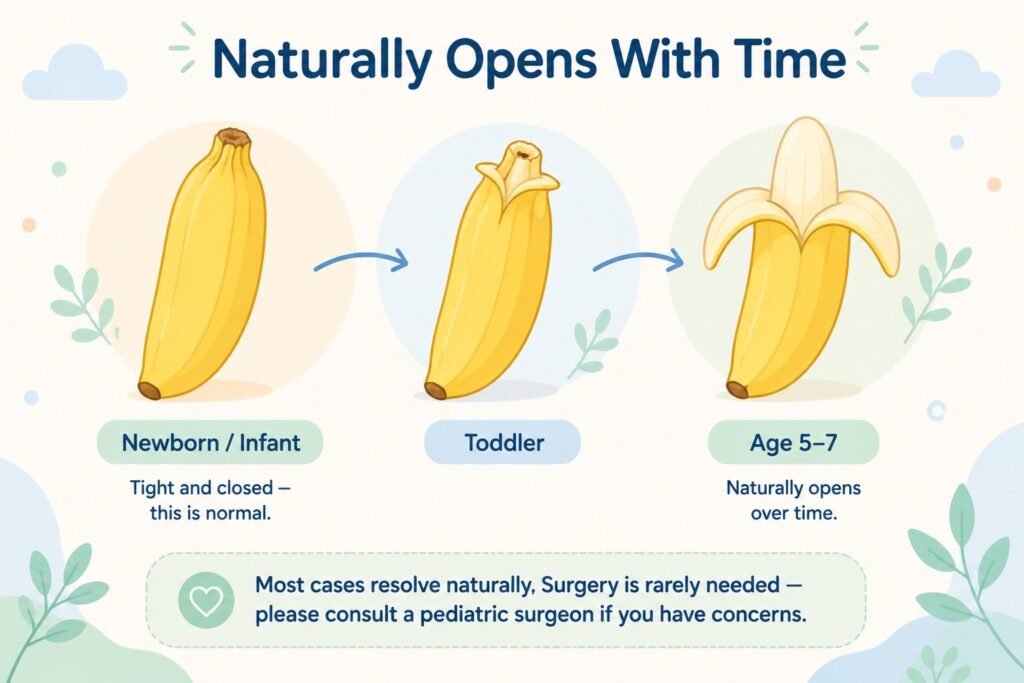
This is how the foreskin normally is in baby boys and young children. At birth, natural bands of tissue (adhesions) stick the foreskin firmly to the head of the penis (glans). Over time, sometimes years, these bands slowly break down on their own.
How many boys can pull back the foreskin, by age (roughly):
- At 1 year: only about 50% of boys can pull back the foreskin
- At 3 years: about 90% can
- By 5 years: almost all boys can (over 95%)
- By puberty (16 years): close to 99% can
So a tight foreskin in a 2 or 3-year-old is fully normal. Do not treat it as a disease.
2. Pathological Phimosis in Children (Needs Treatment)
This is the kind that does need a doctor. It happens when scar tissue forms at the foreskin opening. This is most often because of repeated infections, or a skin problem called BXO (we explain it below). It is rare in babies and toddlers, but more common in older children.
Signs of Phimosis in Children to Watch For
Most boys with physiological phimosis have no signs of trouble at all. The foreskin is just tight, but the child passes urine normally and has no pain. This needs no treatment.
However, see a pediatric surgeon if you notice:
- Ballooning of the foreskin while passing urine: the skin puffs up like a small balloon as the urine struggles to get out
- A weak or split urine stream, or your child has to push to pass urine
- Pain while passing urine, or holding the penis when going
- Repeated infections of the foreskin (balanitis), with redness, swelling and sometimes pus
- Bleeding from the foreskin opening
- The opening of the foreskin looks scarred, white, or stiff (a possible sign of BXO — see below)
- Repeated urinary tract infections (UTIs) in a boy
If your child has had repeated urine infections, also read our guide on recurrent UTIs in children and hidden kidney problems.
What is BXO?
BXO (Balanitis Xerotica Obliterans) is a skin problem. Doctors also call it Lichen Sclerosus. In BXO, the tip of the foreskin becomes white, hard and scarred. It is one of the few clear medical reasons for circumcision in children. It most often shows up in boys aged 5–12 years. So if your child’s foreskin opening looks like a tight white ring instead of normal pink skin, please see a pediatric surgeon.
Treatment of Phimosis in Children: The Step Ladder
Today, good doctors no longer rush to circumcision. When a child needs treatment, we follow a simple ladder: gentle steps first, and surgery only if needed.
Step 1: Watchful Waiting
For most young boys with physiological phimosis and no symptoms, the right answer is nothing at all. Time, gentle washing and patience most often fix the problem. No creams, no surgery, no panic.
Step 2: Steroid Cream
Sometimes the foreskin is still tight at age 5 or older, or there are mild symptoms. Then your surgeon may prescribe a mild steroid cream for the skin (topical steroid cream, such as betamethasone 0.05%). You apply it twice a day for 4–8 weeks, along with very gentle stretching at bath time. Studies show this works in about 80–90% of cases, so the child needs no surgery at all. It is safe and painless, and doctors have studied it well.
Step 3: Preputioplasty (Surgery That Keeps the Foreskin)
But what if the cream does not work and the phimosis causes real problems? Then the next step is a small operation called preputioplasty. The surgeon makes one or two small cuts to widen the foreskin opening, but does not remove it. So the foreskin stays in place, it looks natural, and recovery is quick. This is a great middle option, and many parents do not know about it.
Step 4: Circumcision
We keep true medical circumcision for when all other steps have failed. We also use it when there is BXO, severe scarring or repeated serious infections. It is a day-care procedure, so your child most often goes home the same day. Recovery takes 7–10 days. Today we use stitches that melt away, so no one has to pull stitches out. Most children are back to normal life within a week.
A Note on Circumcision for Faith or Custom
This article looks only at the medical side of phimosis. Circumcision for faith or custom is a separate choice for each family, and this guide does not cover it. But if you do choose it for other reasons, a trained pediatric surgeon should still do it, in a clean (sterile) hospital. This helps avoid problems.
Myths About Phimosis in Children — Busted
Myth 1: “All boys need circumcision for hygiene.”
Not true. Gentle daily washing with plain water keeps an uncut foreskin clean. Also, most big expert groups around the world do not advise circumcision for every boy just to keep clean.
Myth 2: “I should pull back the foreskin forcefully every day to stretch it.”
Please never do this. Pulling it back by force hurts. It causes tiny tears that heal with scar tissue. So it can actually cause pathological phimosis, the very thing you wanted to prevent. Worse, it can lead to a dangerous problem called paraphimosis. Here, the foreskin gets stuck behind the head of the penis and will not go back. This is a medical emergency.
Myth 3: “A tight foreskin in a 3-year-old means he definitely needs surgery.”
Wrong. As we saw earlier, only about 50% of 1-year-olds and 90% of 3-year-olds can fully pull back the foreskin. This is normal growth, not disease.
Myth 4: “Smegma (white stuff) under the foreskin is dirty and dangerous.”
Smegma is harmless and normal, and it clears by itself. It is just old skin cells. You do not need to scrub it out, and it is not a sign of poor hygiene.
Questions About Phimosis in Children
1. My 2-year-old son’s foreskin does not pull back. Should I be worried?
No. This is fully normal at 2 years. Around 90% of boys can pull back the foreskin only by age 3, and many take even longer. So if he passes urine normally, with no pain, swelling or infection, just leave it alone.
2. What is “ballooning” when passing urine, and is it dangerous?
Ballooning is when the tip of the foreskin puffs up like a small balloon. This happens as urine collects under it before coming out. Mild, now-and-then ballooning in a young child is most often harmless and gets better with age. But if ballooning keeps happening, or there is a weak stream or pain on passing urine, see a pediatric surgeon.
3. How safe is steroid cream for a young child?
Steroid cream on a small area of skin for 4–8 weeks is very safe in children, as long as a doctor guides you. Side effects are rare. Also, it works in most cases, so the child needs no surgery at all.
4. Will circumcision affect my son’s sexual function later?
This is a common worry. Studies so far show that circumcision for medical reasons does not greatly change sex life in adults. The real question is whether your son truly needs it in the first place.
5. How quickly does a child recover after circumcision?
Most boys are back to normal play within a week. They can most often go back to school in 5–7 days. Pain is mild, and paracetamol controls it. Also, the result most often looks great when a skilled children’s surgeon does it.
When to Consult Dr. Tanmay Motiwala
Book a visit with a pediatric urologist if your son has any of the symptoms above. Also book one if a doctor has advised circumcision and you want a second opinion first. Or simply come if you want a clear answer on whether your child needs treatment at all.
Dr. Tanmay Motiwala is an AIIMS-trained Pediatric Surgeon & Urologist practicing across leading hospitals in Raipur, Chhattisgarh, treating children from Raipur, Bhilai, Durg, Bilaspur, Rajim, Jagdalpur and across the state. Many of the children he sees with “phimosis” turn out to need only reassurance and time — saving the family an unnecessary surgery.
You may also want to read about undescended testis in baby boys and hernia in children.
📞 Call or WhatsApp: +91 8319084711
📧 Book online: Book an appointment
🌐 Current OPD availability: drmotiwalapediatricsurgeonraipur.com
📋 This article is part of Dr. Motiwala’s Pediatric Urology in Raipur services — see the full range of conditions treated, what to expect, and when to see a pediatric surgeon.
Related conditions parents also read
- Recurrent urine infections & hidden kidney problems
- Hypospadias in newborn boys
- Undescended testis in baby boys
Worried about your child? Dr. Tanmay Motiwala consults in Raipur, Jagdalpur & Rajim. Book an appointment or call +91 83190 84711.
Disclaimer: This article is for educational purposes only and does not replace a clinical consultation. Please consult a qualified pediatric surgeon for personalised medical advice.
⚠️ Important Disclaimer: This article is provided purely for educational and awareness purposes. The information here is not a substitute for medical advice, diagnosis, or treatment, and should not be considered as an OPD or clinical consultation. Every child is different — symptoms that look the same may have different causes. If your child has any of the conditions or symptoms discussed, please consult your nearest qualified pediatric surgeon in person for an examination and personalised advice. In an emergency, go to the nearest hospital immediately.
Further reading for parents: Tight foreskin (phimosis), NHS