 Dr. Tanmay Motiwala
Pediatric Surgeon, Raipur · Updated 30 Sep 2026 · 8 min read
A parent guide to constipation in children. Medically reviewed by Dr. Tanmay Motiwala, MBBS, MCh (Pediatric Surgery), AIIMS-trained Pediatric Surgeon & Urologist | Last reviewed: April 2026 | Reading time: 6 minutes
Few things worry parents more than a child in pain. Your child may look uncomfortable, refuse to go to the toilet, and complain of tummy ache. Perhaps your little one has not passed stool in a few days. Or they cry every time they sit on the potty. You are not alone. Constipation in children is one of the top reasons parents visit a child clinic in India. The good news is that in most cases, you can treat it fully at home.
This guide shows what is normal, what is not, and when to see a child specialist in Raipur.
What is Constipation in Children?
Constipation simply means passing hard stools, fewer than usual, or with pain. It is not just about how often your child goes. It is also about how easy and painless it is.
What is “normal” changes a lot with age:
- Newborns (0–3 months): Anywhere from after every feed to once every 3–4 days can be normal. This is common in breastfed babies.
- Toddlers (1–3 years): Usually 1–2 times per day, sometimes once every 2 days.
- School-age children (4–10 years): Most children go once a day.
A child who passes a soft stool every 3 days without pain is not constipated. A child who passes a hard, painful stool every day is. So what matters is soft stools and comfort, not the calendar.
Why Does Constipation in Children Happen?
In Indian children, the most common reasons are very simple:
- Low fibre diet — too much milk, polished rice, biscuits, and too little fruit, greens and whole grains
- Not drinking enough water, especially in summer or when school gives few toilet breaks
- Holding it in — a child who once had a painful poop often holds it in to avoid pain. This makes the next stool even harder, and the cycle repeats
- Cow’s milk in excess — children who drink more than 500 ml of cow’s milk daily often get constipated
- Toilet avoidance at school — school toilets in India are not always child-friendly. So many children “hold it” until they get home
- Recent change — moving cities, starting a new school, or even toilet training can start it
Signs of Constipation in Children Parents Can Spot at Home
Also, you do not need a doctor to spot constipation. Watch for:
- Stools that look like hard pebbles, balls, or a thick log
- Crying or straining while passing stool
- Streaks of fresh blood on toilet paper (from tiny tears called fissures)
- Stomach pain that comes and goes, and often gets better after a poop
- Poor appetite (“I don’t want to eat” right before mealtimes)
- Soiling underwear with small bits of stool — this is a sign of long-standing constipation, not poor hygiene
- A child hiding behind furniture, crossing legs, or refusing to sit on the potty
Red Flags: When Constipation in Children Needs a Pediatric Surgeon
Your family doctor or child doctor (pediatrician) can manage most constipation. But some warning signs need a pediatric surgeon’s check-up:
- A newborn who did not pass meconium (first stool) within 48 hours of birth
- Ribbon-thin stools in a baby or young child
- Failure to thrive — your child is not gaining weight well
- Severe abdominal distension (a tight, swollen belly)
- Persistent constipation from the very first weeks of life, despite all home steps
- Vomiting green or yellow material and not passing stool
- Constipation with blood in stool that does not stop in 1–2 days
These can be signs of more serious conditions. One is Hirschsprung’s disease. Babies are born with it, and a small part of their bowel has no nerves. Another is anorectal malformation (a problem with how the back passage formed). Both are treatable. But a pediatric surgeon needs to see the child early.
Sometimes a child’s stomach pain becomes sudden, sharp, and severe. If so, please read our guide on Appendicitis in Children: When Stomach Pain Needs Surgery. In its early stage, appendicitis can look like constipation.
How is Constipation in Children Treated?
The good news: about 90% of children get better with simple changes at home. So we always start with the gentlest steps.
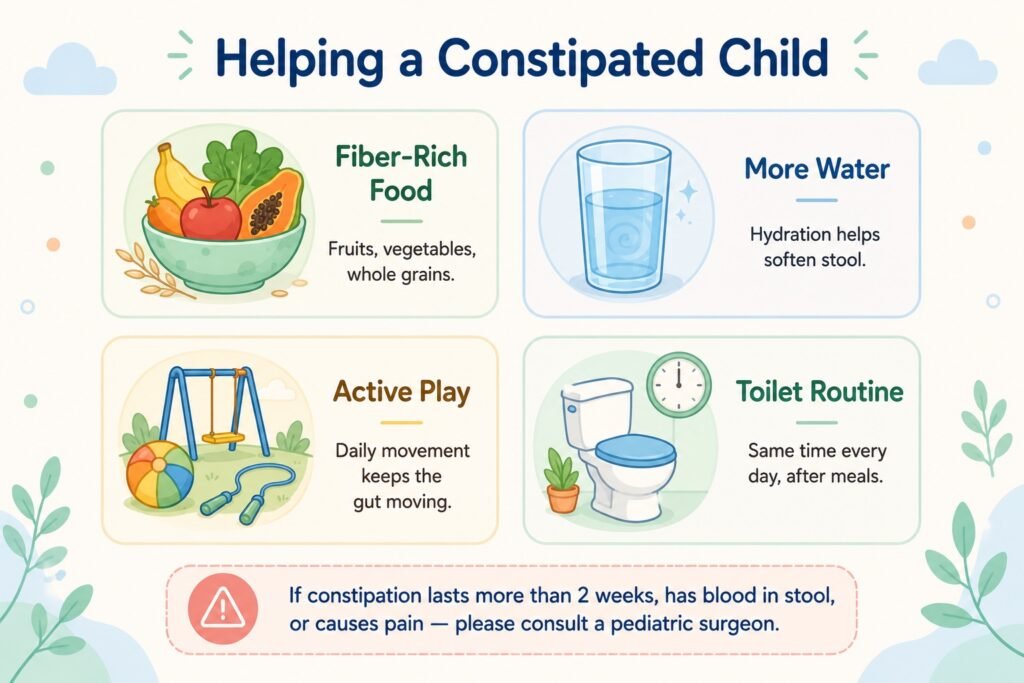
Step 1 — Diet and Fluids
- Add fibre: papaya, pear, apple (with skin), prunes, oranges, sprouts, dal, whole-wheat roti
- Cut down cow’s milk to 300–500 ml/day in toddlers
- Give water all day — at least 4–6 glasses for a 5-year-old
- Also, cut down biscuits, white bread, polished rice, and packaged snacks
Step 2 — Toilet Training Posture
This is the most under-used trick in India, because few parents know it. A child’s body works best when squatting, not when sitting on a high Western toilet with feet dangling. Place a small stool under their feet so their knees come above their hips. This one change makes passing stool much easier.
Ask your child to sit on the toilet for 5 minutes after every meal, even if nothing comes. This builds a healthy habit.
Step 3 — Medical Help
If diet changes do not work in 2–3 weeks, your doctor may prescribe a gentle laxative (a medicine that softens stool). Examples are lactulose, polyethylene glycol (PEG/Movicol), or mild stool softeners. Please do not be afraid of these. When a child specialist prescribes them, they are safe even for long-term use. They are not habit-forming. The aim is to keep stools soft for many weeks. Then the child loses the fear of going.
Step 4 — Surgical Evaluation
Routine constipation in children rarely needs surgery. We only consider an operation if there is a problem in how the bowel formed (like Hirschsprung’s disease). In those cases, the operation works very well and gives the child a normal life. Read more about when a child really needs surgery.
Myths About Constipation in Children — Busted
Myth 1: “A spoonful of ghee or oil will fix it.”
No scientific proof shows that ghee or oil cures long-standing constipation. A balanced diet with some healthy fats is good. But ghee alone will not soften a hard, stuck stool. So do not delay proper treatment for this remedy.
Myth 2: “My child has fever because of constipation.”
Constipation does not cause fever. If your child has fever AND constipation, something else is causing the fever. Your doctor needs to check it separately.
Myth 3: “Laxatives are dangerous and addictive.”
Modern child laxatives like polyethylene glycol stay in the bowel; the body does not absorb them. They are safe even for months when a doctor prescribes them. Also, they do far less harm than long-term pain and fissures (small tears).
Frequently Asked Questions
1. My 6-month-old breastfed baby goes only once in 5 days. Is that constipation?
Probably not. Babies who take only breast milk can normally go anywhere from 8 times a day to once a week. This is fine as long as the stool is soft and the baby is comfortable.
2. Should I give my toddler isabgol (psyllium husk)?
Only if a doctor advises it. Too much isabgol without enough water can make constipation worse in young children.
3. My child bleeds a little while passing stool. Is this serious?
A small streak of bright red blood usually comes from a tiny tear (anal fissure). A hard stool causes this tear. It heals once stools become soft. But if bleeding is heavy, dark, or lasts more than 1–2 days, see a doctor.
4. How long does it take to fully treat childhood constipation?
For example, mild cases improve in 1–2 weeks. Long-standing constipation often needs 3–6 months of treatment. This retrains the bowel and breaks the fear cycle.
5. Is constipation hereditary?
It can run in families. But lifestyle and diet matter much more than genes.
When to Consult Dr. Tanmay Motiwala
Is it time to see a pediatric surgeon? Yes, if constipation has lasted more than 4 weeks despite diet changes. Also yes if your child has any red-flag sign above, or severe stomach pain with constipation.
Dr. Tanmay Motiwala is an AIIMS-trained Pediatric Surgeon and Urologist practicing across leading hospitals in Raipur, Chhattisgarh, treating children from Raipur, Bhilai, Durg, Bilaspur, Rajim, Jagdalpur and across the state.
📞 Call or WhatsApp: +91 8319084711
📧 Book online: Book an appointment
🌐 Current OPD availability: Check the homepage at drmotiwalapediatricsurgeonraipur.com
📋 This article is part of Dr. Motiwala’s Pediatric Colorectal & Anorectal Surgery in Raipur services — see the full range of conditions treated, what to expect, and when to see a pediatric surgeon.
Related conditions parents also read
- Hirschsprung disease
- Anorectal malformation (born without a normal anal opening)
- Appendicitis in children
Worried about your child? Dr. Tanmay Motiwala consults in Raipur, Jagdalpur & Rajim. Book an appointment or call +91 83190 84711.
Disclaimer: This article is for educational purposes only and does not replace a clinical consultation. Please consult a qualified pediatric surgeon for personalised medical advice.
⚠️ Important Disclaimer: This article is provided purely for educational and awareness purposes. The information here is not a substitute for medical advice, diagnosis, or treatment, and should not be considered as an OPD or clinical consultation. Every child is different — symptoms that look the same may have different causes. If your child has any of the conditions or symptoms discussed, please consult your nearest qualified pediatric surgeon in person for an examination and personalised advice. In an emergency, go to the nearest hospital immediately.
Further reading for parents: Constipation in children, NHS