
 Dr. Tanmay Motiwala
Pediatric Surgeon, Raipur · Updated 30 Sep 2026 · 6 min read
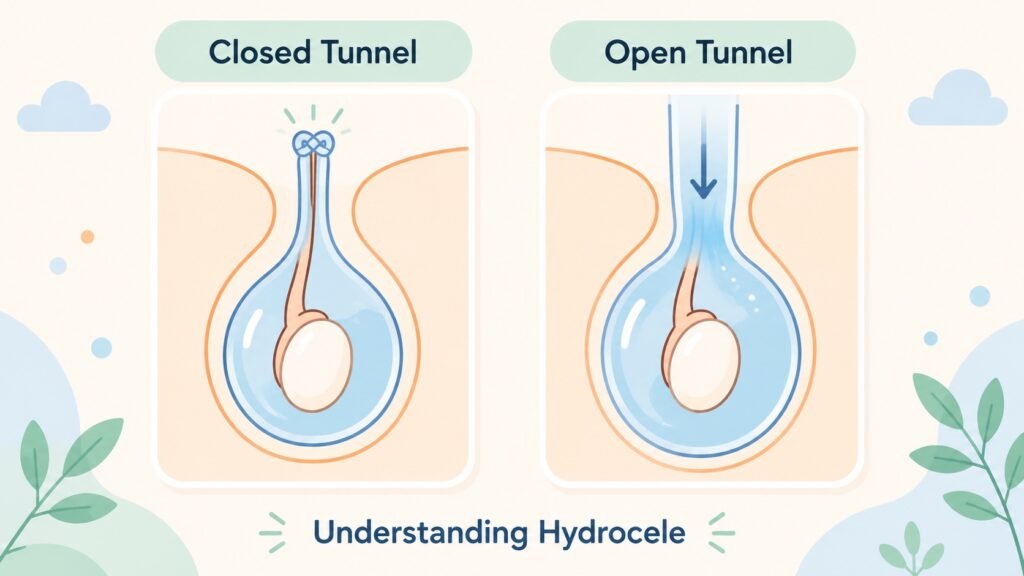
Have you noticed that one side of your baby boy’s scrotum looks bigger than the other? Or that the swelling grows when he cries and shrinks when he sleeps? Most likely, it is a hydrocele. Hydrocele in babies is very common.
It is one of the most common problems I see in my pediatric surgery clinic in Raipur — and one that parents worry about far more than they need to. In most babies, a hydrocele needs patience, not surgery.
What Is a Hydrocele in Babies?
A hydrocele is simply fluid around the testicle. The testicle itself is healthy. It is just sitting inside a small pocket of water, which is why the scrotum looks puffy and feels soft.
Why does this happen? Before birth, the testicle travels from inside the tummy down into the scrotum through a small tunnel. Normally, this tunnel closes before birth. If it stays even slightly open, a little fluid from the tummy can drip down into the scrotum. That is a hydrocele.
There are two simple types:
- Closed type — The tunnel has closed, but some fluid stayed behind. The swelling stays the same size all day.
- Open type — The tunnel is still open. The swelling grows when the baby is upright or crying, and shrinks when he lies down.
How Common Is Hydrocele in Babies?
Very common. About 1 in 20 newborn boys has a hydrocele. At birth, the tunnel is still open in most baby boys — it just hasn’t finished closing yet. So a hydrocele in a newborn is almost never an emergency.
Hydrocele or Hernia? How Are They Different?
Parents often worry the swelling might be a hernia. Both start from the same little tunnel — but a hernia carries a piece of intestine, while a hydrocele carries only fluid. A hernia can become serious; a simple hydrocele almost never does.
Here is how we tell them apart in clinic:
- A hydrocele glows when we hold a small torch against the skin (it lights up like a balloon of water).
- We can feel a normal cord above a hydrocele. A hernia goes up further into the groin.
- A hydrocele drains slowly when the baby lies down. A hernia pops back in more suddenly.
One important rule: never let anyone drain a scrotal swelling with a needle to “test” what it is. Diagnosis is by examination, nothing more.
Will a Hydrocele in Babies Go Away on Its Own?
Yes — in most babies. The tunnel keeps closing in the first months of life, and the body slowly absorbs the trapped fluid. Most hydroceles disappear by 1 to 2 years of age.
So the right plan for a healthy baby with a soft, painless hydrocele is simple: watch and wait. You do not need medicines, massage or tight clothes. Just regular follow-up.
When Does Hydrocele in Babies Need Surgery?
Surgery becomes the right answer if:
- The hydrocele is still there after 18–24 months of age.
- The swelling is growing, tense, or uncomfortable.
- We cannot rule out a hernia.
A simple hydrocele does not damage the testicle, does not cause infertility later in life, and is not painful. So we have time to decide — there is no need to rush a newborn into the operating room.
What Is the Surgery Like?
Hydrocele surgery in children is completely different from the operation done in adults. We do not cut open the scrotum.
- The surgeon makes a small cut (about 2 cm) in the natural crease of the groin.
- Then the surgeon gently separates the open tunnel from the cord and ties it off near the tummy wall.
- The fluid drains out, and the body absorbs anything left over.
The operation takes about 30–45 minutes under general anaesthesia. It is a day-care surgery — your child comes in the morning and goes home the same evening.
After Surgery
- Some swelling or bruising of the scrotum is normal and settles in 4–6 weeks.
- Paracetamol eases mild discomfort for a day or two.
- Stitches dissolve on their own — nothing to remove.
- Children return to school in 4–5 days and to running and sports in about 2 weeks.
- Recurrence is uncommon. Serious problems are very rare in trained hands.
Common Questions Parents Ask
Will this affect his fertility later? No.
Did we cause it? No. It is something the baby has from birth.
Can it affect both sides? Yes, though one side (usually the right) is more common.
Should I press or massage it? No. Pressure does not help, and your baby does not need it.
When to See a Pediatric Surgeon
Come in for a consultation if:
- The swelling is still there after 18 months.
- It is growing or hard.
- The swelling becomes sudden, painful, hard, or red — this is an emergency, go straight to the hospital.
A pediatric surgeon, not a general surgeon, is the right specialist for children. The surgery in a small child is delicate and very different from the adult version.
Dr. Tanmay Motiwala is a pediatric surgeon practising in Raipur, Chhattisgarh. He performs day-care hydrocele and hernia repairs for babies and children. To book a consultation, visit the Contact page or call the clinic directly.
Related reading:
- My Child Has a Swelling Near the Groin — Could It Be a Hernia?
- Is Surgery Safe for My Child? 7 Questions Every Parent Asks
Sources: Coran’s Pediatric Surgery (7th ed); Rob & Smith Operative Pediatric Surgery (7th ed); DK Gupta Pediatric Surgery Vol 1. Further reading for parents: Hydrocele, MedlinePlus (US National Library of Medicine).
📋 This article is part of Dr. Motiwala’s Pediatric Urology in Raipur services — see the full range of conditions treated, what to expect, and when to see a pediatric surgeon.
Related conditions parents also read
- Inguinal hernia in children (groin swelling)
- Undescended testis in baby boys
- Testicular torsion (sudden testicle pain)
Worried about your child? Dr. Tanmay Motiwala consults in Raipur, Jagdalpur & Rajim. Book an appointment or call +91 83190 84711.
⚠️ Important Disclaimer: This article is provided purely for educational and awareness purposes. The information here is not a substitute for medical advice, diagnosis, or treatment, and should not be considered as an OPD or clinical consultation. Every child is different — symptoms that look the same may have different causes. If your child has any of the conditions or symptoms discussed, please consult your nearest qualified pediatric surgeon in person for an examination and personalised advice. In an emergency, go to the nearest hospital immediately.